
Membership of Type allows unlimited access to our online library. Join to support new research and writing on the design of the built environment.
You can read more about membership here.
Already a member? Login to your account to avail of unlimited downloads.

Membership of Type allows unlimited access to our online library.
Join to support new research and writing on the design of the built environment.
You can read more about membership here.
Individual Membership Fees
Individual membership is available on a monthly or annual basis.
The fee is €10/month or €99/year.

MB: When I started the podcast seven years ago, the decline in architectural criticism had already been notable for years — in the loss of dedicated critic positions, the shrinking cultural authority of criticism and the migration of discourse away from newspapers and toward fragmented digital platforms. Attention had shifted toward listicles, images, or promotional pieces masquerading as criticism. Architecture writing became something more akin to clickbait. That was part of my reason for starting the podcast. I wasn't finding the coverage of architecture I was hungry for, so I decided to go out and speak with architects myself. At the same time, I was listening to — and still listen to — a lot of podcasts, and I find the long-form interview is an ideal way to pay sustained attention to a subject. It's an opportunity to sink into someone's ideas and follow a line of reasoning through, with less distraction than visual or screen-based media.
I always enjoyed shows like Bookworm [1], hosted by Michael Silverblatt out of KCRW in Santa Monica, where every week he'd speak with a different novelist about a recently published book. Over the past 30 years he's spoken with some of the greatest literary figures in the world, and he has a way of cutting through the PR exercise of a public interview and getting to the heart of the writer's work and their motivations — sharing insights you wouldn't expect from a journalist. It's a much more intimate format.
Another I listened to fanatically was Longform [2], an hour-long interview each week with a different journalist about a recent piece they'd written. It offered a level of intimacy around someone's craft that you don't see on a screen.
MB: This is probably one of the hardest questions to answer, because the editorial intent has always been fairly subconscious. But it was likely informed by my background in English literature and my interest in architecture as an outsider to the discipline.
I read a lot of Geoff Manaugh's writing on BLDGBLOG [3], a blog from the aughts heavily inspired by writers like J.G. Ballard, ie: people who saw architecture always in connection with a wider set of influences. So architecture was always an expanded field to me, which has informed who I speak with. It's not just architects, but artists, designers, landscape architects, novelists, poets — people whose work might not be rooted in practice but is, at least in my view, connected to it.
MB: There's been a real atrophy of architectural criticism — but really it's more a decline of the public intellectual more broadly, tied to much larger shifts in media. Criticism is no longer a top-down process where experts at prestige publications impart their knowledge to a readership. Instead it's much more democratic and messy and specific, with more people expounding to much smaller audiences. That's part of why podcasts have proliferated in the past decade.
There are still good architecture critics, don’t get me wrong — I read Olly Wainwright [4] and Christopher Hawthorne [5] , and there are many others behind paywalls now whom I once read more often — Edwin Heathcote [6] and Rowan Moore [7], for example.
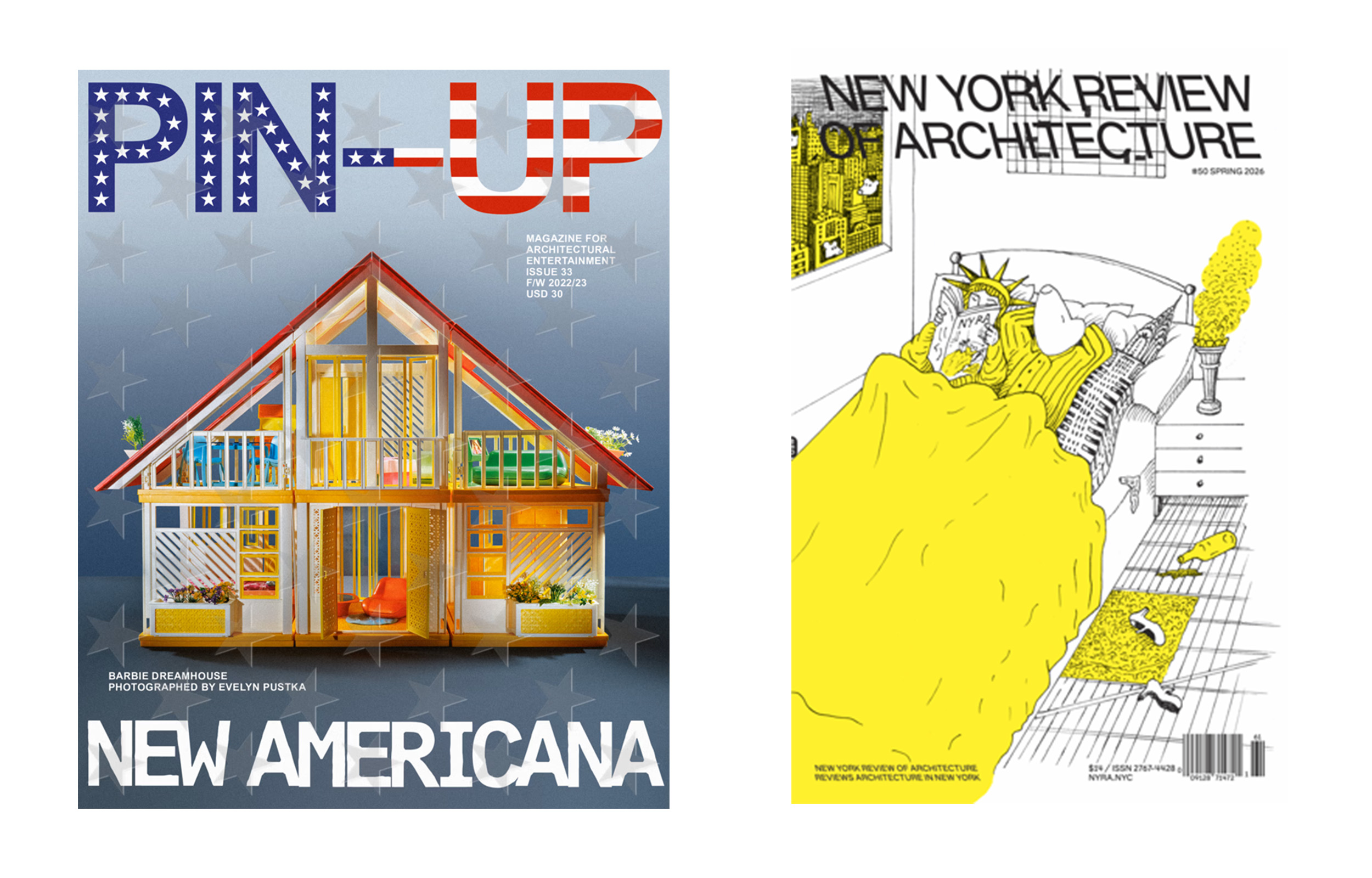
There are publications like PIN-UP [8], which balances rigour with a real sense of glamour and sex appeal, as far as architectural writing goes at least, and the New York Review of Architecture [9] which to me is one of the most exciting publishers of architectural criticism today. The most recent issue of NYRA features a face-off review of Foster’s 270 Park Avenue, between Paul Goldberger and Mark Krotov. There's a sense of drama to how the essays are formatted, running in parallel across the gutter of the paper, and the writing itself is sophisticated, entertaining and at times exhilarating.
I know I’ve veered away from the question of criticism and towards architecture writing more broadly, but it’s worth mentioning here for readers that the two pieces of recent writing I hold close to my heart are both works of long form journalism, and both from the New Yorker: Ian Parker’s 2024 piece on Kanye West’s Tadao Ando-designed Malibu house [12], which braids together the stories of West, Ando and the contractor living on site who was being paid by West to destroy the building. The other is Sam Knight’s 2023 piece on a young architect who struggles to reconcile his radical environmental vision with the realities of the mainstream architecture industry. [13] This isn’t formal architectural criticism, but in some ways far better!
MB: It's funny — Bookworm doesn't exist anymore. Michael had a stroke and isn't able to work. Longform ended two years ago. And in my own media diet, especially my podcast diet, it's more and more material that is functional and efficient — about digesting current events, or improving my health or productivity. The culture of optimisation really feels all-pervasive now.
There's less space for a kind of intellectual engagement that on the face of things isn't useful or productive, but on a much deeper, almost spiritual level is still fulfilling. That's a high-minded way of putting it, and I don't think I get close to achieving it — but it's something I always looked for. When I was a student in English literature and listening to shows like Bookworm, it was kind of like going to church and having revelations. I don't think we value that, or look for it, in the same way now — at least not in the discussions about architecture we have.
A lot of mainstream architectural criticism now leads with carbon footprints, housing affordability, labour conditions, displacement, accessibility, or the politics of who's commissioning what. These are urgent and legitimate frames, but they tend to displace an older register of criticism — the kind that focused on atmosphere, proportion, threshold, light, the phenomenology of moving through a space. There's arguably less attention paid to the experiential qualities of the built environment in architectural criticism today, because they don't always have this moral or utilitarian edge.
MB: There's the term TLDR — too long, didn't read, just give me the bullet points. And increasingly, popular architectural writing is probably formatted in that manner.
But the interesting, experimental writing I've been reading lately — most recently from an artist named Jaakko Pallasvuo [14] , who's based in Finland — is that the text isn't really a product. Becoming a product isn't the point. The writing he and a lot of his contemporaries do is interested in rendering the labyrinth of thinking, and having the reader follow that labyrinth and take pleasure in the process of thought unfolding. It's very resistant to summary or artificial synopsis — if you tried to apply that to writing like Pallasvuo’s, it becomes totally insufficient, so much weaker than the original.
A long-form interview can work the same way: it meanders, you're not sure where it might go, and at its best it's totally dependent on two minds being open to some kind of mutual discovery. That frankly doesn't happen often, but it's the aspiration — that there's an element of chance and even magic when you get two brains together unpacking ideas, exposing themselves in ways that might not happen on a page or in front of an audience, revealing underlying forces or preoccupations that would be hard to uncover otherwise.
MB: I think it's even harder to bypass the sales pitch with architects than with other cultural workers, because architecture is so bound up in capital and risk and reputation that all good architects are, by definition, excellent salesmen.
And there's another layer to it: architects are notorious for speaking in a very inaccessible way about buildings — precisely, I think, because their medium is space and material and light, things that are effectively ineffable. So we always do a pretty bad job of talking about architecture.
Part of the challenge of having a genuine conversation with an architect is creating the conditions where they can speak more freely. There's a kind of conversation that architects (and artists, writers, etc) rarely get to have, which is one where the interviewer isn't extracting a quote or a story that flatters (or flattens) the project. It’s this extractive frame that produces guardedness. What dissolves it is usually some demonstration that you're genuinely curious about the same questions they are.
MB: I just had this image of the magician on stage performing some miraculous feat — which is maybe a useful metaphor for the architect, who can make building look so easy and fun at the same time, when in fact there's often so much agony that goes hand in hand with the design of a building, or any creative act. For publicity's sake, all of that is masked or concealed.
One of the aims of the podcast is to pull back that curtain — to take the struggle and the complexity as the subject matter, not the perfect final image.
MB: Architecture makes us acutely aware of how form and content, or style and substance, are inextricably bound. Language is part of that. You can't entirely separate the rhetoric of a text from its fundamental meaning. You have to accept that it's as much about how we frame things, how we decide to look at them, versus how they really are. I've always enjoyed that puzzle — trying to get as close to what I feel is the “real thing.”
And there's this thing I often mention when asked to explain the podcast: the name Scaffold is really about language and how it both supports and obscures the object of interpretation. Buildings are so dependent on rhetoric to be made sense of, and the way you describe something changes the way you see and understand it. But at the same time there's an innate property to a building that you maybe start to lose touch with as you focus more on the language around it. The words can get in the way. Somehow I am drawn to that contradiction.
MB: I always record a lot more than I publish, even if the final episode might still seem sprawling and rambling. I see the interview as a process of almost panning for gold — I accept there will be a lot of unusable material, probably down to my own lack of skill in conducting the original conversation, and I'll edit quite rigorously to keep the most valuable parts.
MB: I'm extremely self-conscious as a writer, and I'll often erase and rewrite to such an extent that it's hard to make any progress at all. With a conversation, you can't go back. You're on the train, moving forward, and self-censorship or self-criticism is replaced by a sense of urgency — to express, in the moment, to the best of your ability, what you're trying to say.
I like the pressure of the conversation, that you have an audience, that the words simply must arrive one after the other — sometimes even before you really know what you're going to say. There's something exciting and beautiful and mysterious about the process of speaking. For a time, I would actually sit in on Quaker meetings for that reason, and it's a similar kind of dynamic: you sit in a circle, and at some point someone just begins to speak. It comes from somewhere else — somewhere less conscious, and more revealing. Ideally, every interview becomes like a Quaker meeting of two.

Working Hard / Hardly Working is supported by the Arts Council through the Arts Grant Funding Award 2026.
What might happen if we began to see buildings as living creatures? Would it change how we design, build and treat them? Would we choose different materials at the design stage, and put more care into their construction or restoration? Would we be more willing to maintain them, and less likely to abandon them or accept their neglect?
Once I began to learn about roof thatching in Ireland, or vernacular buildings as a whole, I started to see them as living beings, and it was difficult to unsee. Old abandoned houses were now even more heartbreaking, like seeing an animal on its deathbed. A house with its lime plaster fallen away, exposing its mud innards, now seemed violent.
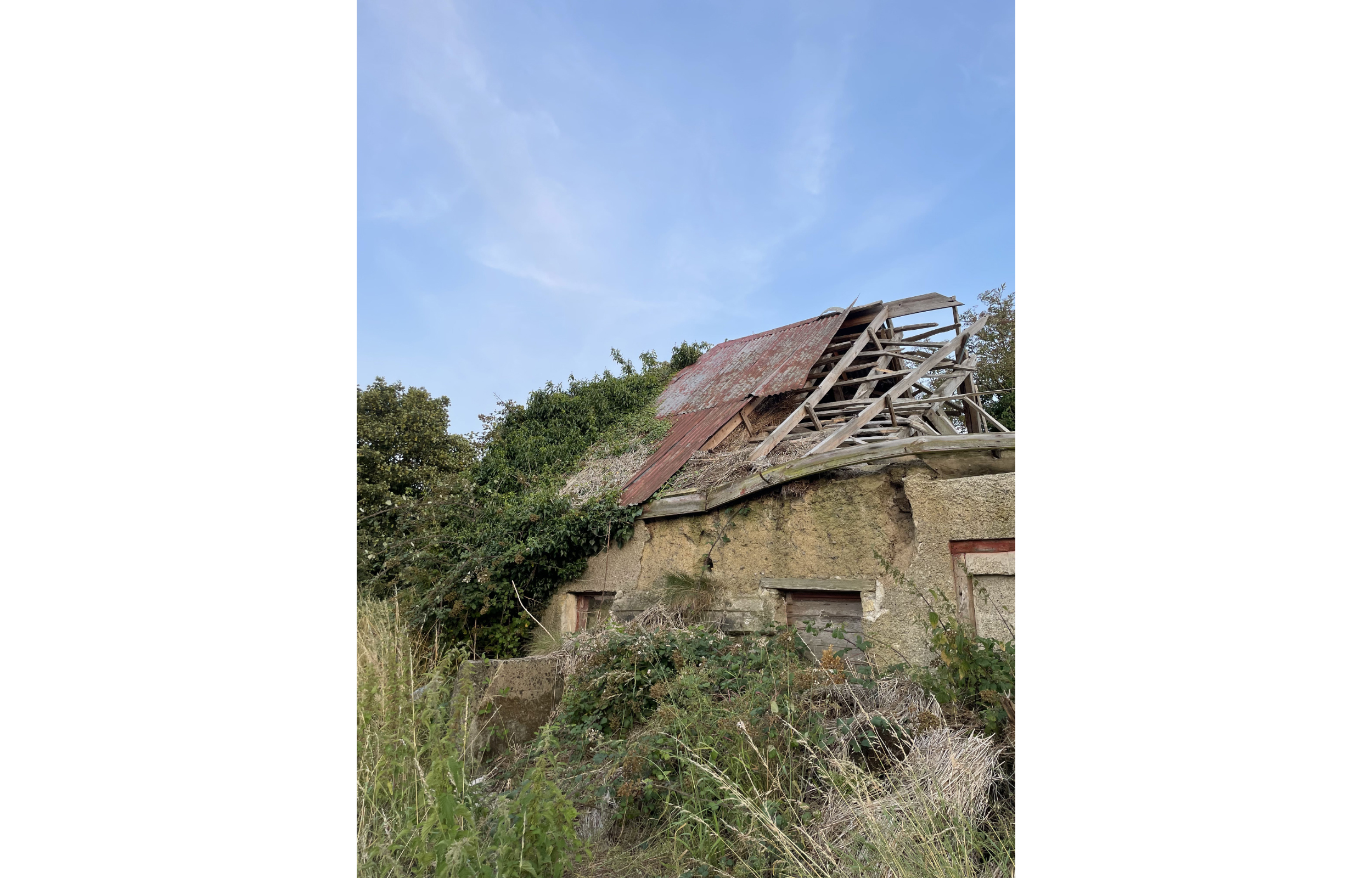
Despite the effort of the remaining thatchers in Ireland and the commitment of thatched homeowners to their maintenance, working with a critically endangered craft feels like trying to wake a sleeping giant. Imagine the effort it would take to get yourself to your feet after you’ve been laid to rest or been fully buried by most people as the world “moves on”. When I see the state of some thatched cottages in Ireland, I’m often left wondering should we just let it die, regularly exclaiming “slate the goddamn thing”. But it’s so ancient it's familiar to us all, it awakens the senses through the sounds, sights and smells.
These “living creatures” shared a symbiotic relationship with their inhabitants; people built and maintained them, relying on a continued connection to their surroundings to source the materials for lime washing, thatching, and keeping the fire going, while the home sheltered the people, allowing them to gather around a fire to stay warm, cook and tell stories – to share the workload with their neighbours when the house needed thatching.
“The use of local building materials meant that they fitted into landscapes of which they were literally a part, their clay or stone walls gathered from the earth on the spot, their timbers dug from the bogs, their thatch harvested from the fields.” - E. Estyn Evans, 1957 [1]
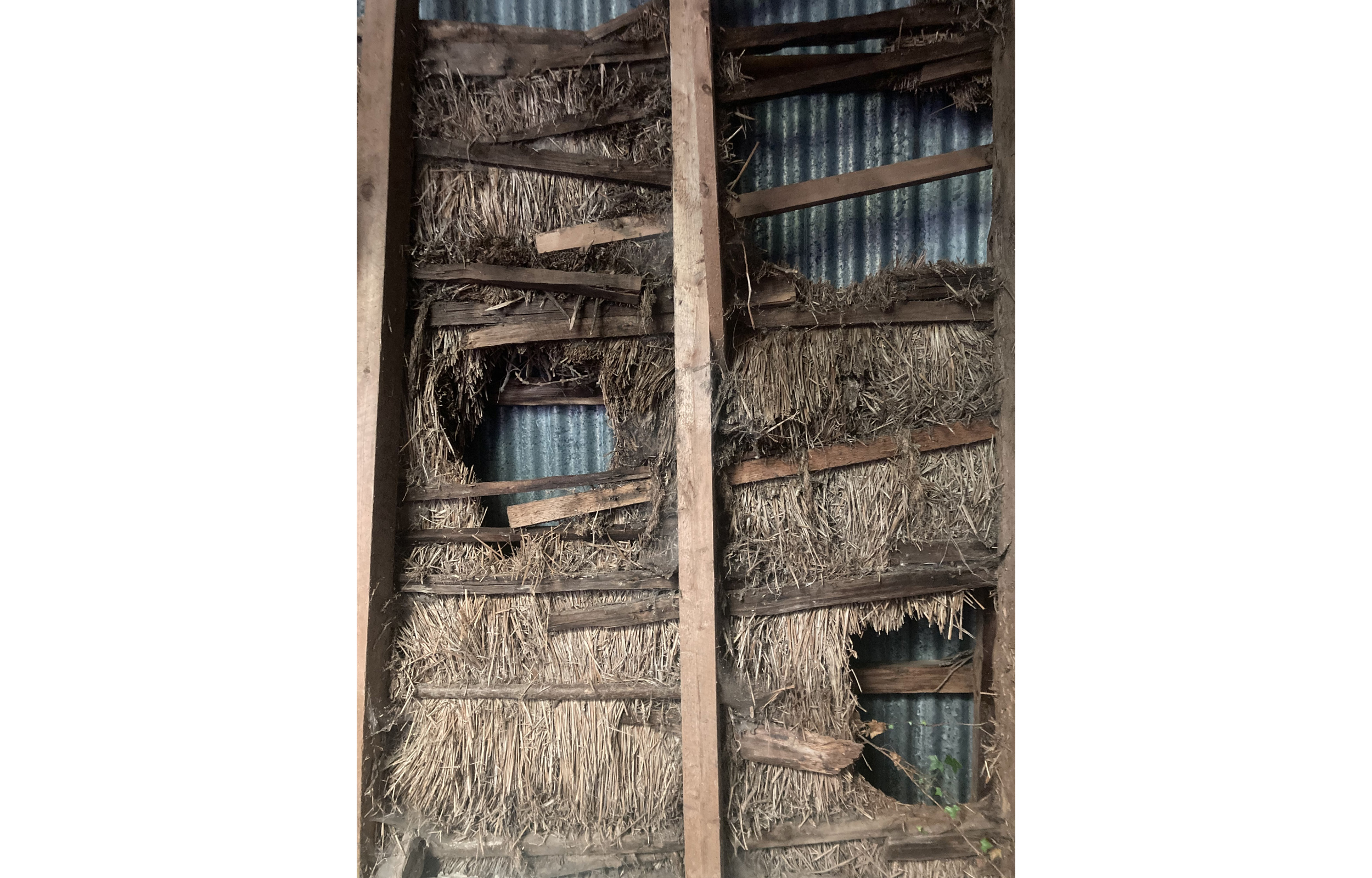
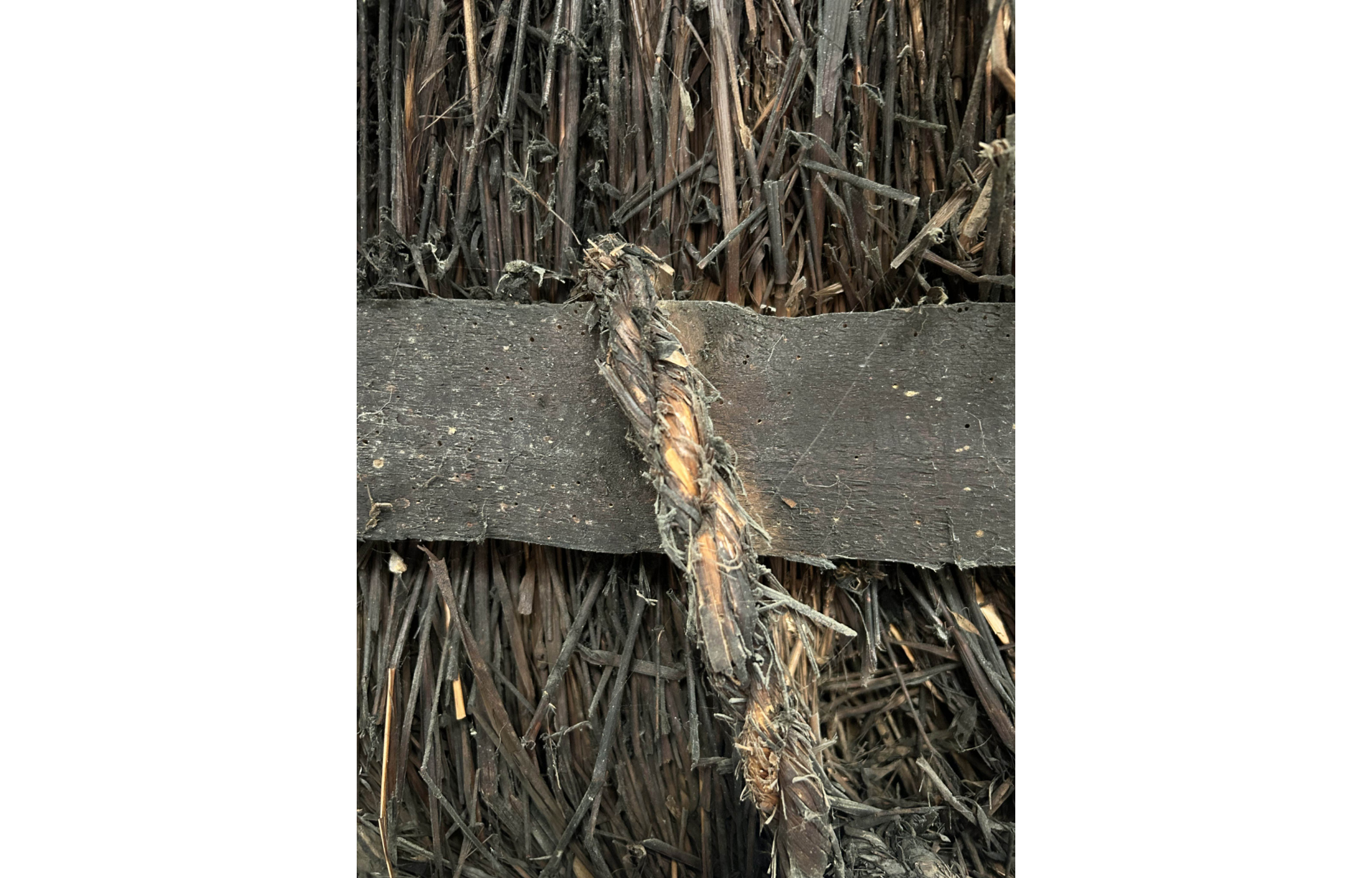
Old thatched houses have a presence to them, it can feel like encountering a giant beast, and thatching them can feel like giving it a new shaggy coat for winter. Dressing up weather wounds when its base coat has become exposed can feel like a surgical procedure. Examining the condition of the roof structure in the attic feels like glimpsing into a dusty ribcage made of bog wood and branches, sometimes coated with fibrous scraw (the top layer of the bog), or thatch tied directly to its skeletal structure with handmade sugán rope. Smoke blackened by the well-tended hearth beneath, like the lungs of a lifelong smoker. Hearing ghost stories about the house; as we expose the historic layers of straw we disrupt ancient dust, wondering if we are at risk of being haunted by its spirits.
There are many reasons for the drawn-out death of thatching, the obvious being the lack of thatchers. The ancient craft has been struggling to survive for the last 70 years or so, despite it being a distinguishing feature of Irish vernacular architecture. As a result, we often encounter them in a state of emergency, with not enough time or support to save them. It’s a beautiful thing to work with a compostable material, but not when it’s composting on top of someone's historic home.
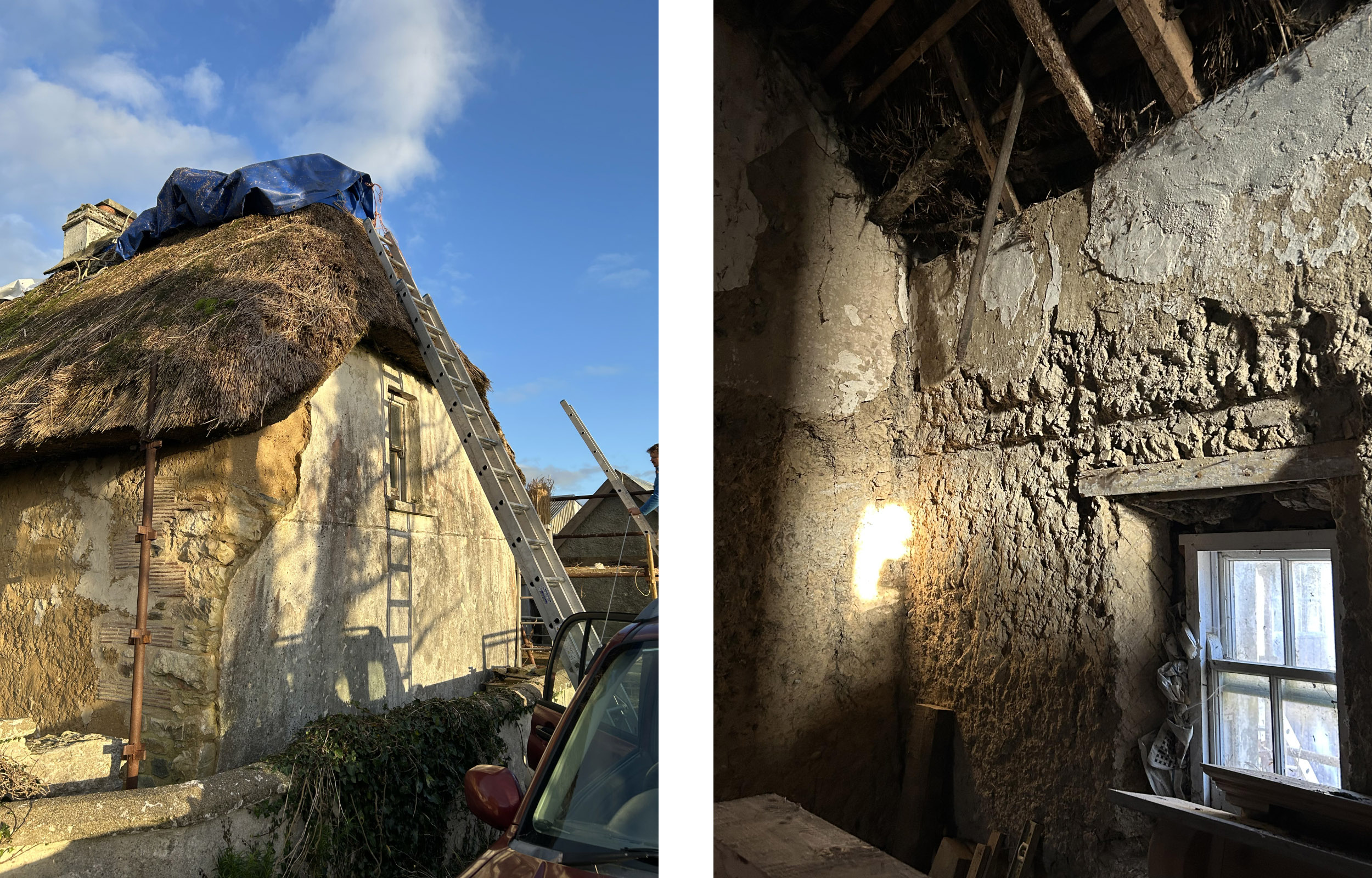
Ceann tuí (head of straw) is the Irish term for thatched house, indicating how common straw was as a thatching material. But the term became less and less appropriate over the last century for various reasons. When combine harvesters convenienced our world, it rendered straw unsuitable for thatching. Also, the adoption of more wind-resilient varieties led to shorter straw, too short for thatching. This contributed to the significant decline in the number of iconic thatched houses across the country. Northern Ireland, for example, had 40,000 thatched buildings in the 1950s, but today has only 180. [2]
People's perspectives on thatched buildings can sometimes feel reminiscent of the way the Irish language was viewed for so long: something that should be left in the past, that we didn’t need, associated with poverty, peasantry and tough times. It feels as though something is shifting with the Irish language in that regard. Could the same be happening for our endangered heritage crafts? With the urgency to adapt a carbon-heavy, wasteful industry that relies heavily on imported and non-biodegradable materials, and to create more climate-resilient homes - under which we will need to escape rising temperatures - could thatched roofs make a comeback? Or could they be seen as even more of a fire risk, when wildfires become the norm for us in Ireland, any more than a timber-frame house insulated with Kingspan?
There’s talk of the tourism industry in Ireland adapting to the changing climate with the installation of air conditioning in accommodation. It seems unfortunate and disjointed that this is the solution to climate resilience for an industry that gives visitors a glimpse into Irish culture.
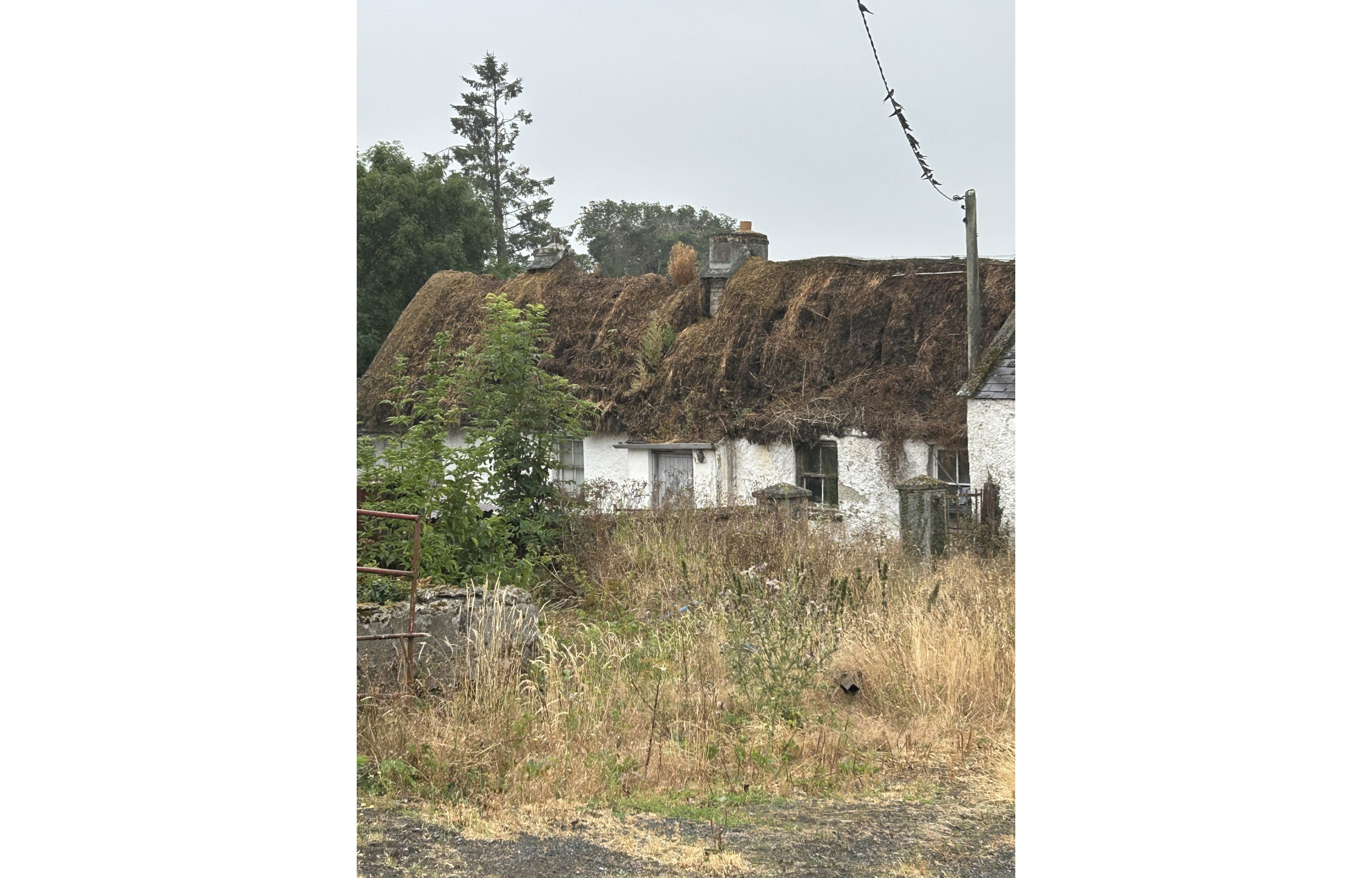
The stark reality is that today in Ireland even roof thatching is significantly reliant on imported materials to keep the craft alive. The recent fuel strikes this year, however, reminded us all how precarious the global supply chains are, for food and many other imported goods. Thatching material is now imported from as far away as China, and we would have little backup if the supply ceased entirely.
Though there is a supply of Irish thatching materials, it is very limited, and nothing should be in endless supply if we are to live within planetary boundaries. Water reed is still harvested by hand around the Shannon Estuary among other places, an ancient trade in itself, and there are a few farmers still passionate enough to grow heritage grains for thatching straw. But the challenges around growing straw or harvesting reed put most off. The health of our soil and rivers deeply affects the quality of the materials too, which shortens their life on the roof.
Ultimately, growing a building material has multiple ecological and environmental benefits: water reed, for example, is a regenerative plant that absorbs carbon, helps clean water, provides habitats for birds and insects, and the fresh growth of a managed bed is more climate resilient than an unmanaged reed bed, as it holds more water. Its byproduct is a building material that keeps a home's internal atmosphere regulated at different times of year. It also provides a habitat on your roof for insects, sometimes even bees or birds. Though that could be still seen as a negative to some.
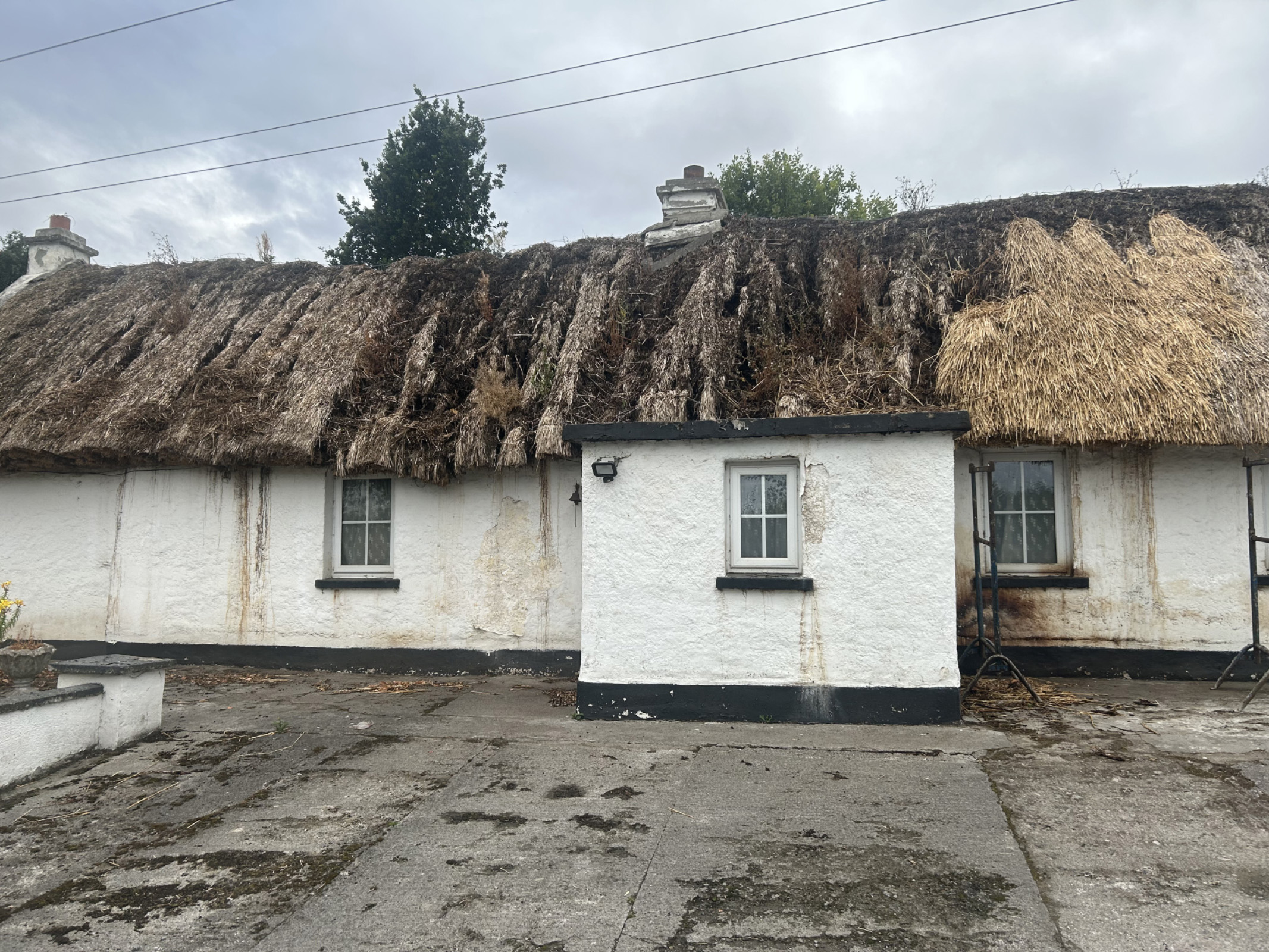
Today there is an expectation for a roof to last a minimum of 20 years. And despite there being grants available for homeowners, the price to thatch a roof today would mean you’d want it to last at least that. We have collectively forgotten these skills, perhaps by design, where something that was once common knowledge is now a specialised skill.
The modern world's expectation to have longevity, consistency and convenience has infiltrated a craft that would have used straw from the field next door and shared the work with the neighbours, and if it lasted a few years, that’d do…
Fear of maintenance influences our approach to modern design and construction, and seems to be steeped in an embedded colonial fear of nature, and the need to suppress it. That buildings must remain static and more machine-like. The maintenance of vernacular buildings, however, required a continued connection and familiarity with the place from which it was built and its local materials.
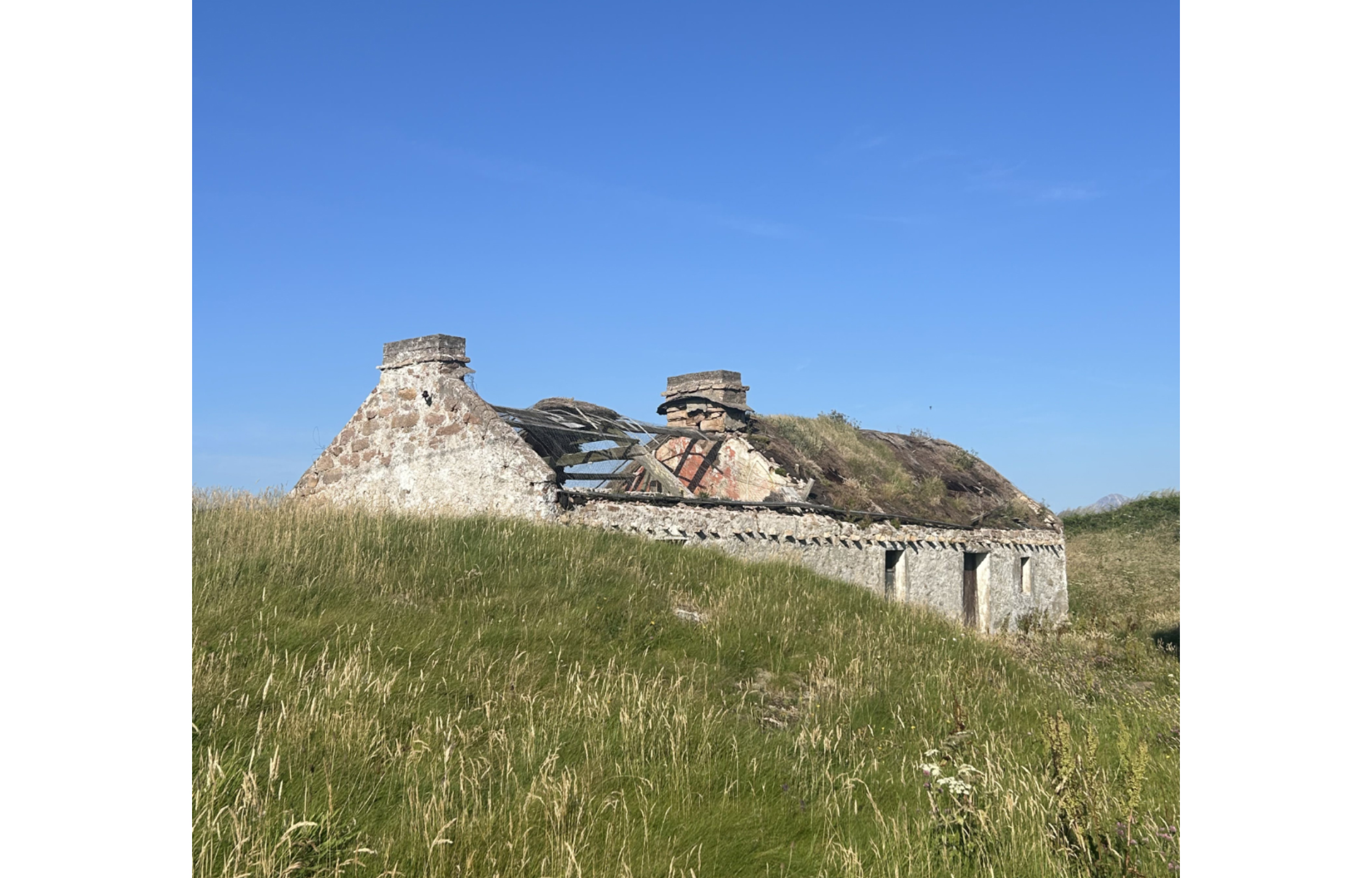
They are more than just our built heritage; more than a picturesque cottage on a Fáilte Ireland postcard. It may seem like a small issue amongst the many issues we are facing, however, these are often peoples homes, protected structures, and our last remaining heritage buildings and examples of Irish vernacular architecture.
It seems their fitting into the landscape so successfully has caused them to be overlooked or undervalued as examples of sustainable architecture. That these simple structures can just dissolve to the earth gives me a feeling of hope. Containing clues to the past, they act as libraries of ancient attunement and understanding in how to truly build sustainably and in harmony with nature. Perhaps this is not an end to, or death of, something – but the last phase of a cycle. If we were to cast ourselves forward, what might the new cycle look like? And might it weave us back into the delicate tapestry of land, nature, and human connection?
Reflecting on her time spent thatching Irish homes, Alice Bowler considers what an endangered craft might teach us about care, materials and building in step with the land.
Read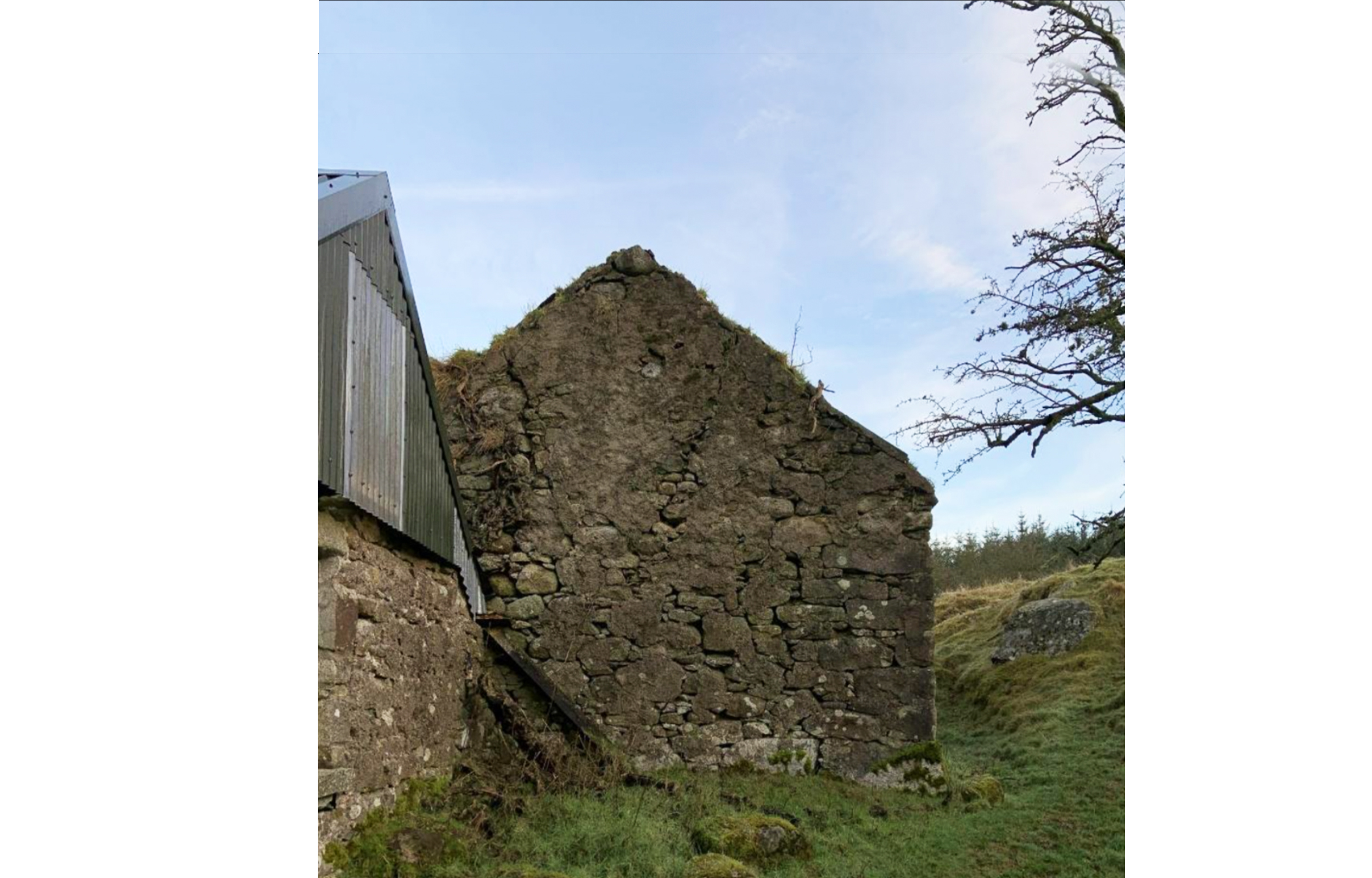
My first job in architecture was with a small practice in the Wicklow village of Ballyknockan. I spent three summers designing one-off houses across the county's hillsides and valleys. Working within the stringent requirements of Wicklow County Council, in a landscape designated as an ‘Area of Outstanding Natural Beauty’ [1], demanded careful negotiation between planning policy, client ambition and the landscape itself. Occasionally that process produced inventive architectural solutions. More often, however, it resulted in another familiar bungalow, little different from the one that had secured permission for the previous generation.
Towards the end of my time at this firm, I noticed an increased client workload. There was an ever-growing appetite to pursue constructing a new dwelling on family lands, in some instances by people who, like me, were in their early twenties. Initially, I was surprised that so many people were seeking to build on family land in rural Wicklow. I had spent my entire adolescence listening to siblings and peers alike voice their eagerness to move to towns, cities or abroad, anywhere with a more vibrant social scene than our village of eight hundred people. Looking past the naivety of youth, the true reason for this change was obvious. Spiralling urban house prices, remote working and changing attitudes to where people could live had transformed the economics of rural life.
It is a combination of the above factors that instigated the resurgence of the rural one-off house we are currently witnessing. This residential typology has been under scrutiny for some time, and perhaps rightly so. [2] They undermine the towns and villages they surround, promote car dependence and make their mark on the natural landscape. [3]
During the Celtic Tiger era, there was an effort to manage the spread of this typology with the government introducing the Sustainable Rural Housing Guidelines for Planning Authorities (2005) [4]. Local Authorities attempted to limit their construction to those with a strong tie to said rural areas and only when they could demonstrate an economic or social requirement to build them. The criteria to qualify had become laborious requiring various verifications to demonstrate qualification such as proof of, at a minimum, ten years living in the area, or alternatively, strong connection to the agricultural industry.
The restrictive nature outlined above inevitably led to an increase in planning refusals, prompting calls for an ease of planning restrictions from local communities. As the government looks to meet its housing targets, it seeks to diversify how it can reach them. One avenue they have examined is the rural one-off house, which is having its policy reviewed for the first time in twenty years. A new national planning statement is being prepared. Included within is an upgrade to the rural guidelines, aimed to improve transparency and certainty for people applying to build their own home, enabling more consistent decisions between various local authorities and supporting balanced rural development aligned with national policy. [5]
The outcome and success of this proposed legislation is yet to be seen. Despite the bureaucratic blockades on getting approval for rural housing, the stock that is currently produced tends to be subpar from a design perspective. If we are about to witness a new era of rural development, can we encourage thoughtful design and prevent a rerun of bungalow bliss of the 1970s or the explosion of McMansions we witnessed during the Celtic Tiger years? Local Authorities across the country currently provide design guidelines [6], but what we tend to see is house after house sitting on a one-acre site with the usual unfinished hardcore drive, concrete kerbing and a severe lack of biodiversity in landscape design.
If we are to see an increase in rural housing stock, how do we improve design quality while mitigating its environmental impact? Perhaps the answer lies not in inventing new suburban hybrids, but in looking back at how rural settlements naturally formed.
The traditional Irish Hamlet, or Clachán, was an organic cluster of dwellings that minimised landscape disruption, consolidated services like wells and drainage, and naturally concentrated movement into localised nodes. [7] By planning for multi-generational living from the outset, this model could provide a dignified, cohesive framework for families to adapt over time, replacing the current ad-hoc reality of ribbon development with high quality, landscape led architecture.
In my experience surveying farmyards that were being prepared to make way for new dwellings; what struck me was how carefully they had been sited. Buildings leaned into hedgerows for shelter from prevailing winds, stepped with the contours rather than against them, and formed sheltered yards at their centre. There is something worth recovering here, not simply the appearance of traditional farmyards, but the logic that shaped them. [8]
Where suburban estates attempt an awkward compromise between the urban and the rural, importing standardised road geometry, concrete block boundaries, tarmac turnarounds and uniform setbacks into open country; the clustered farmyard layout, by contrast, is wholly rural. It draws on the spatial principles of landscape led design where varying building volumes step with topography, lean into existing hedgerows and share a central courtyard.
The modern take on the farmyard layout is well positioned as a potential multi-dwelling solution for rural contexts. This format allows families to collate and pool financial resources to create a home, and provides the potential for multi-generational living. The layout allows for different typologies to exist in a cluster. Families can rotate through units as they progress through their life. The family live in a main house; their children grow up and use the smaller adjacent buildings to establish their own independent households away from the main homestay. As the parents age and look to downsize the family rotates, parents use the smaller dwellings, thus the cycle continues. This avoids the building of suburban style bungalows in a back land fashion; it keeps development compact and rural in character.
This format is not just suited to the nuclear family, but also provides potential for households in various formats, the variation in dwelling provides options for diversity, single households who wish to remain in a rural setting but find it difficult to find stock that is suited in size. This provides variety.
A study undertaken by Teagasc and the Heritage Council [8] documented the various typologies of farmyard layouts, which offer options and formats depending on the user’s needs:
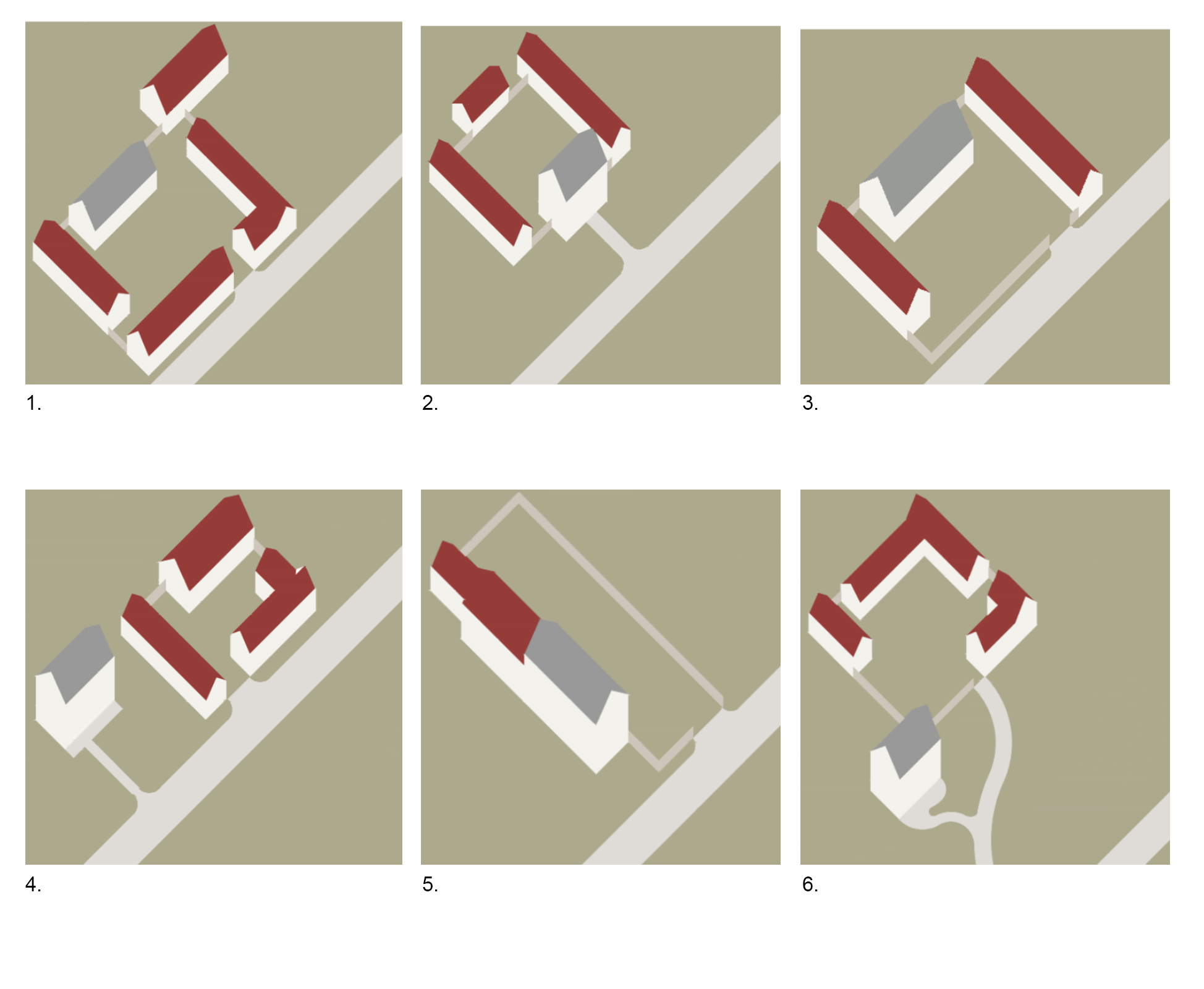
1. Scattered Farmyard:
Traditionally found within the mountainous districts, particularly in the west of Ireland, where level ground is in short supply.
2. Small courtyard:
Buildings on three sides; the fourth side is a boundary wall. The dwelling faces the road. This layout is particularly common in Ulster, Western Connacht or south-west Munster.
3. Half Courtyard:
Buildings form two ranges at right angles to each other.
4. Full Courtyard:
A range of buildings close off all four sides of a rectangular yard.
5. Extended Farmyard:
Found mainly in the northern half of Ireland, a single row of buildings.
6. Detached Courtyard:
Mainly associated with the landlord estates of Ireland but can also be found on some of the larger traditional farms.
These layouts provide both a historic precedent and a viable spatial framework, the scattered farmyard, for instance, offered tailored response to sites with challenging topography. Most importantly, all these formats generate an informal, shared public realm, delivering an open space at a proportion and scale that avoids the sprawling, ecologically sterile lawns of modern single dwelling builds.
In effect, this approach delivers on the original, unfulfilled promise of suburbia, a synthesis of rural landscape and neighbouring community, but without the suburban sprawl. It opens a form of “micro-suburbia” accessible to those who wish to live rurally but lack the vast resources or family land required for a standalone “McMansion”.
Critically the barrier to this model is not that it is strictly prohibited by planning law, but that it lacks any administrative template or active promotion. Current local authority guidance remains fixated on regulating the individual detached house, offering no path or precedent for clustered development. Reimagining rural housing requires overcoming not just policy inertia, but a deep-seated cultural obsession with the isolated gated homestead. By shifting our perspective, we can demonstrate that shared courtyards and close neighbours do not compromise rural privacy, they build genuine, resilient communities.
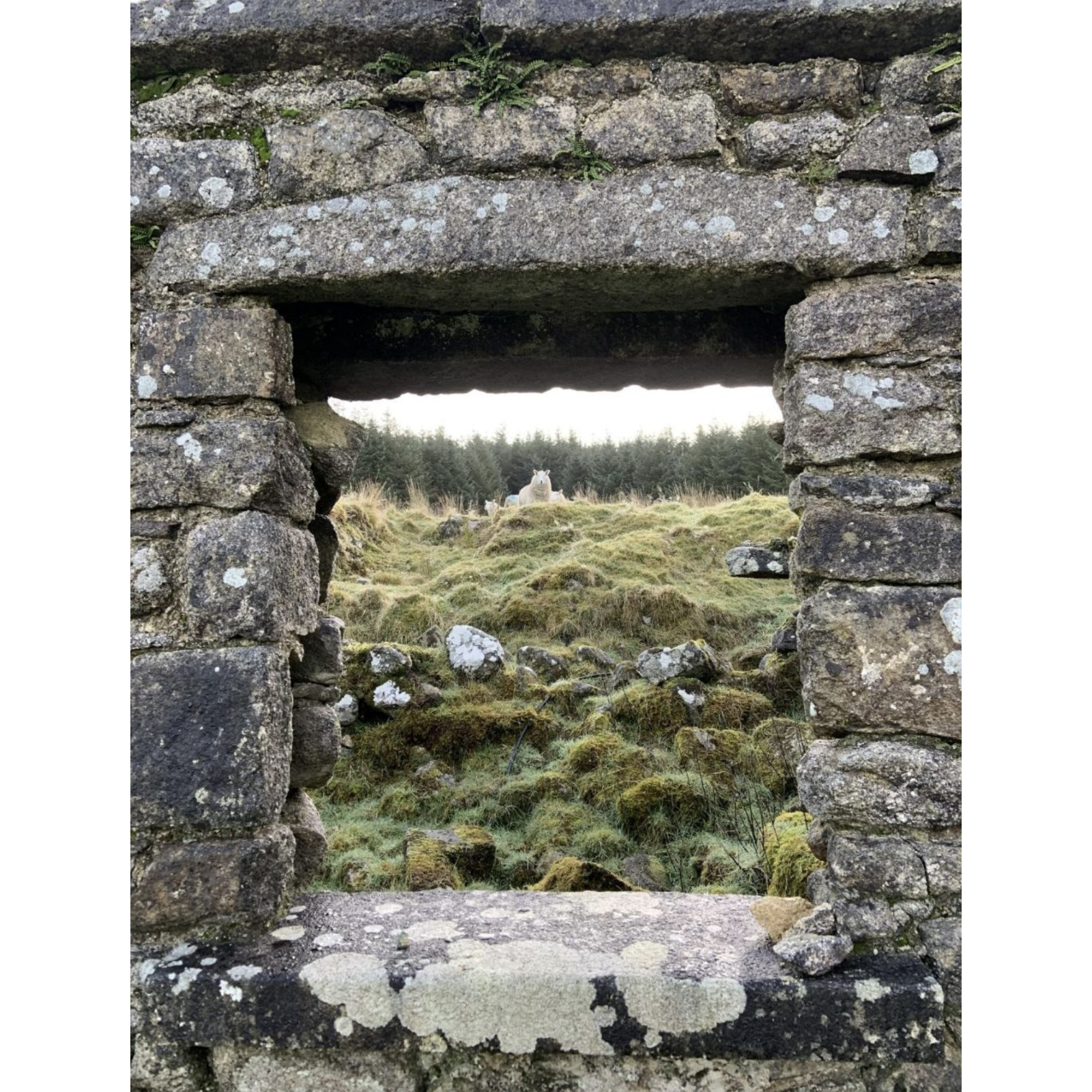
Some readers may highlight what I am describing is a village and that rural villages are in decline and arguably the way to cure this is to bring people back into them. However, as is the case with Carnew and Dunlavin in South Wicklow, there are caps on the housing stock that can be developed in many of these areas - limiting population growth from the outset. How can we expect these communities to grow and thrive when their development is being hampered? [1] As well as this, both had new schools proposed and granted full planning permission back in 2023 but as of 2026 both projects are stalled in Stage 2b. (9) This demonstrates the systematic challenges of reinvigorating our rural towns and villages, it will take time for them to accommodate their growing populations.
The debate surrounding one-off housing has too often been framed as a choice between preservation and development. It need not be, If we are to reimagine and move forward with contemporary notions of rural housing, a more considered and holistic approach is required than the all or nothing rhetoric that often dominates the discourse. If Ireland is entering a new chapter of rural planning, then architecture has an opportunity, and a responsibility, to shape it differently. The success of the next generation of one-off houses should not be measured by the number of permissions granted, but by whether they strengthen communities, respect the landscape and create places worth inheriting.
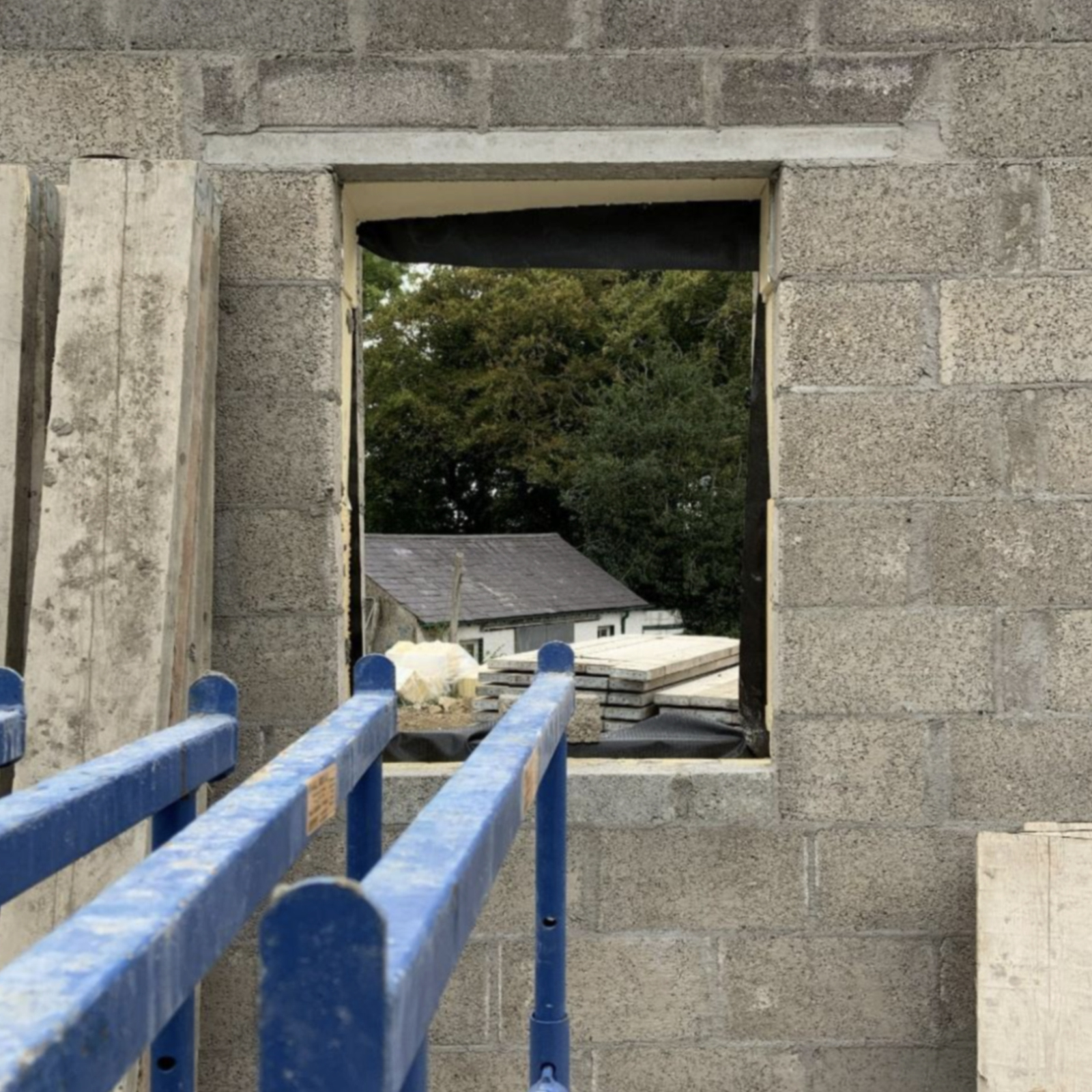
In this article, Joseph Kavanagh explores the resurgence of the rural one-off house, its polarising legacy, and whether the typology could be reimagined as a vehicle for collective living to support rural communities.
Read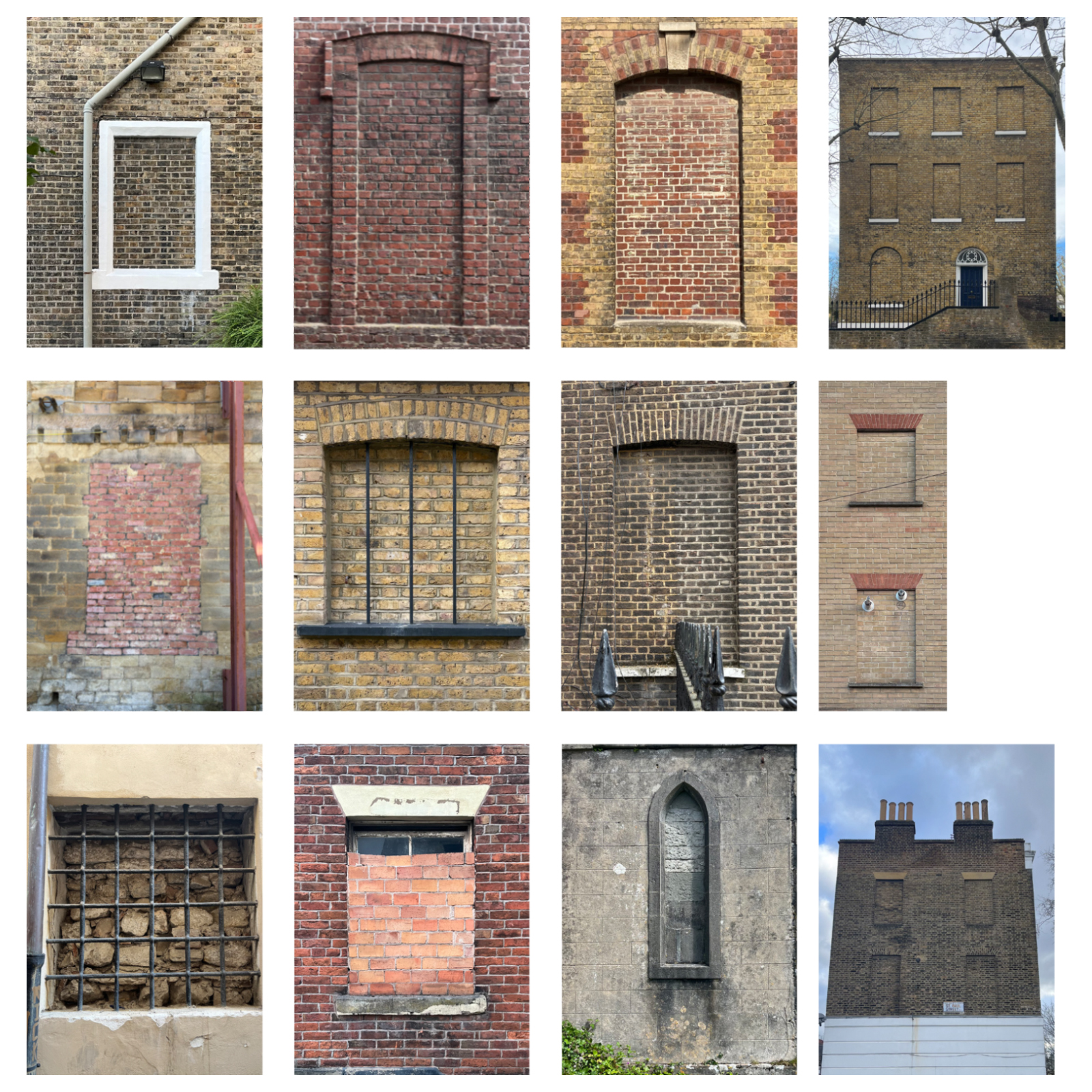
Almost accidental, what I noticed on a long walk through Georgian Dublin during my Covid-era masters. A Joycean pilgrimage of sorts; as I referred to it at the time. The kind of walk that only really makes sense when there is no end destination or objective; head up, moving slowly, paying particular attention to things that do not obviously demand it. I was outside; the city [or even the imposed 5-kilometre radius for that matter] was the only material I had to work with.
I began noticing them the way you notice anything in a place walked long enough. First, an irregularity; then, a recurrence; and eventually, a quiet population of peculiar instances. A small rectangle of brickwork, its colour not quite conforming with the rest of the patchwork. Mortar slightly younger, lines a little too neat. You might see it as a window that has kept its shape but abandoned its purpose. Passing it without thinking, later the eye returns; and I can’t say why. They appear the way a new word would; suddenly everywhere, in sentences you were certain never contained it before. The smallest of absences settled calmly into the streetscape, never quite dramatic enough to halt a passer-by, never misplaced enough to provoke alarm.
What I had been calling a blocked window is perhaps more accurately described as blind. The name is more fitting than it first appears. They are not sightless exactly; they see nothing, but they are seen. They look like windows. They just no longer look out.
Windows normally behave with discipline. They repeat across a façade with the certainty of grammar: opening, wall, opening, wall. A rhythm the eye follows almost without instruction. A blind window interrupts this established order without quite breaking it. The shape remains obedient to the pattern, but the depth has disappeared. The eye expects reflection, even an essence of interior life, but is instead met with brick where the gaze once was. The building nearly seems to mispronounce itself or stutter; you begin to reread.
The usual explanation arrives quickly at this point: the window tax. [1] Count the openings, charge the owner, watch the windows disappear. A convenient explanation, likely even; but not the full one.
Blind windows predate the tax by some distance. They appear in earlier European façades [2] not through force but through composition; a way of holding rhythm, completing symmetry, or resolving something that would otherwise falter. In these cases, the window never intended to open. It existed to make the building read correctly. The tax simply gave the practice a more pragmatic justification. Brick replaced glass, light was traded for economy, and the outline stayed put. Dickens complained, accurately enough I would add, that the state had found away to charge people for what nature had provided freely. [3] But the behaviour itself was already commonplace.
I believe that the important point is this: the blind window is not only something removed. It is something intentional, something designed.
Georgian architecture in particular seemed comfortable with this ambiguity. Windows were used to complete symmetry, to maintain the rhythm of a façade even where the internal arrangement refused to cooperate. This is the part that tends to get lost in the window-tax story; the blocked opening might not always mark something lost, sometimes it marks something that was never intended to exist in the first place. Depending on how charitable you are feeling, is either an act of architectural control or a very convincing illusion.
Some closures followed other forms of adaptation. Houses once built for single families were divided into smaller dwellings. Townhouses became offices, then flats and then offices again. Fire regulations changed [not sure if much needs to be said here, given the regulatory sphere that we find ourselves operating in], internal staircases moved, corridors appeared where rooms had previously opened freely onto one another. A window that once lit a stairwell or overlooked a neighbouring garden, simply ceased to make sense within the new arrangement of life. Cities are this funny phenomenon, whereby they rarely demolish themselves wholesale. They revise themselves instead; slowly. Piecemeal.
Remove an opening and the room reorganises itself almost immediately. Furniture shifts. Services take the wall. Artificial light replaces daylight. The interior absorbs the loss and continues. From the street this transformation is almost invisible. The brick presents only a fact of closure, while behind it, the room has redistributed its functions elsewhere. The sealed aperture becomes less an ending and more a prompt; a small engine for rearrangement, quietly encouraging the interior to find a different equilibrium.
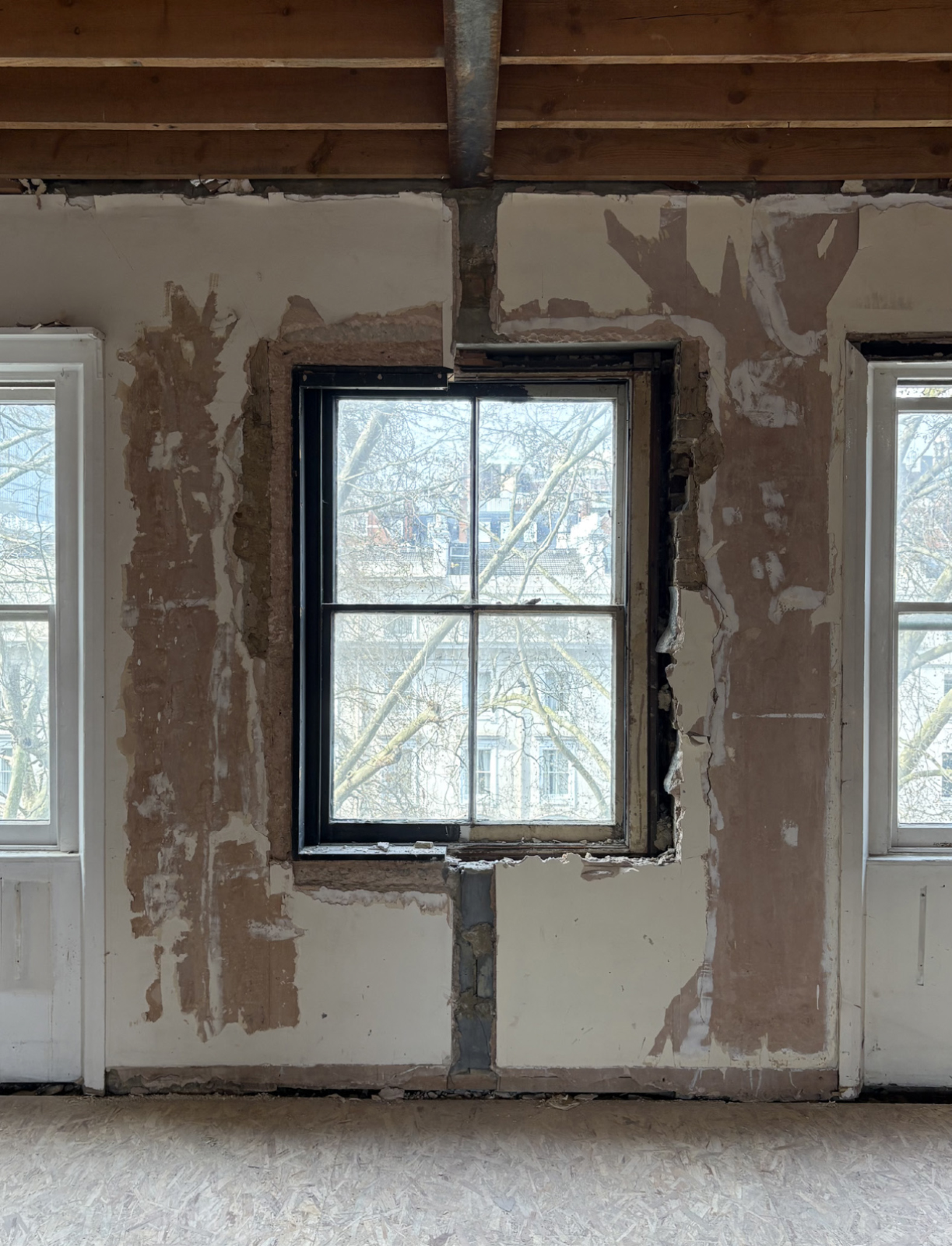
On a recent project, this split between façade and interior became unusually clear. A Victorian sash window reads normally in elevation: frame, glazing, proportions intact. Behind it, the opening had been filled to allow a partition wall to bisect the room, forming two dormitory bedrooms from one. During enabling works, the infill was temporarily removed to inspect the condition of the original sash. A brief moment saw the room’s depth return. Daylight reaching the reveal again, briefly, as if it had been waiting. And just like that, the window lost its gaze again. Without, the façade never told.
Window, wall, window, wall.
Once this split is understood, blind windows begin to look less like accident and more like method.
Contemporary projects use them deliberately: to maintain the cadence of a terrace where a real opening would create overlooking problems; to complete an elevation where internal planning might refuse to cooperate; to keep a building legible within a stricter urban order.
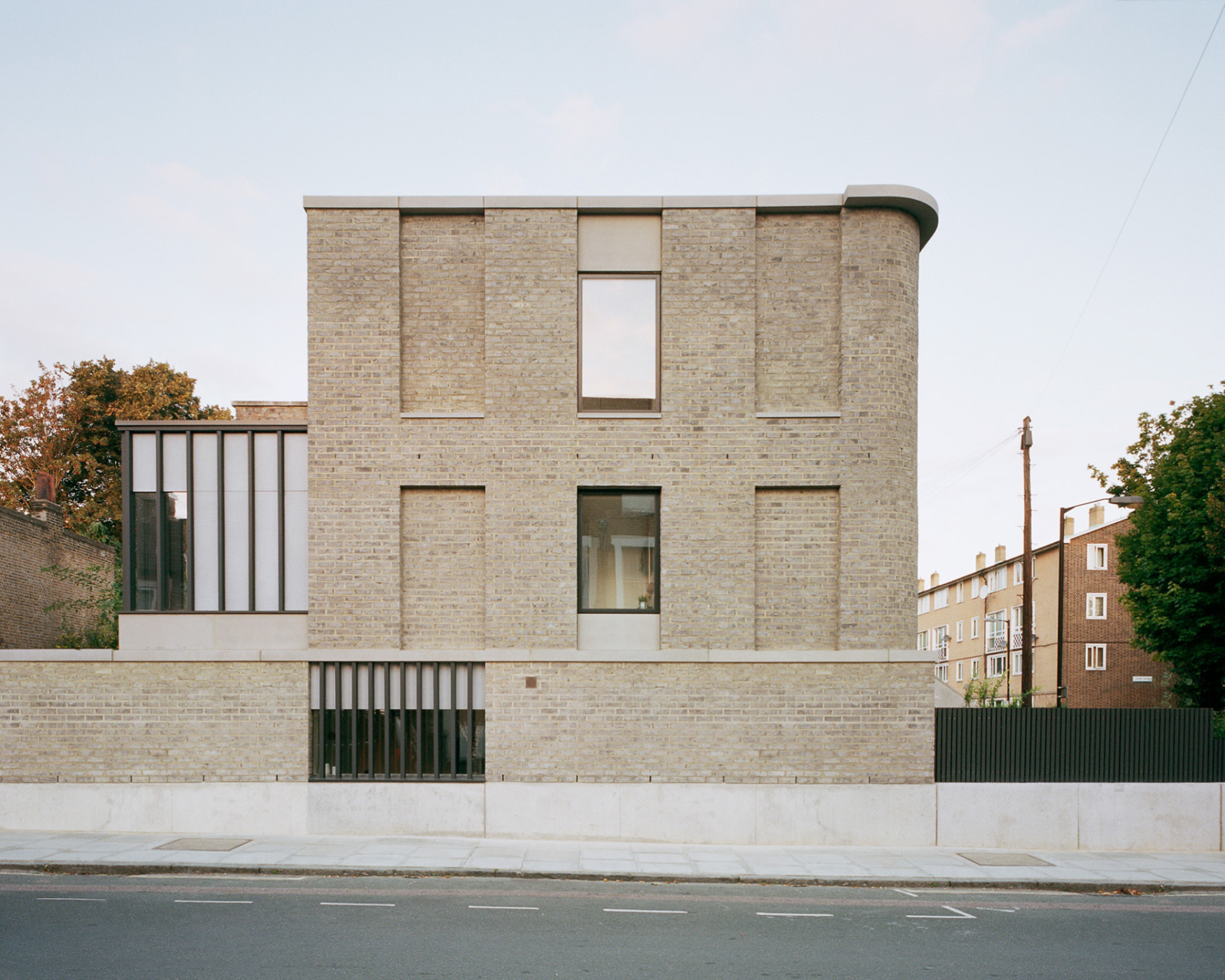
Corner House by 31/44 Architects in Peckham [4] is one such example of this, and one I happened across by accident on a walk from New Cross to Brixton with a friend, somewhere between the second pub and a particularly tasty plate of cumin hand-pulled noodles at Silk Road. A new-build house tucked onto a side-plot street corner beyond the established building line, only ever so slightly announcing itself. The side elevation uses blind windows to turn the corner of the façade with a modesty that mimics what might once have been a full flank wall of sealed openings on an end of Georgian terrace. On the front, a shift in the depth of the brickwork above the entrance marks where the neighbouring terrace has a window and this building does not; a quiet acknowledgement of what is absent, handled with enough restraint that most people would walk straight past it.
Robert Venturi argued that architecture is at its most interesting when it accepts contradiction rather than resolving it; when things are allowed to be both one thing and another simultaneously. [5] The blind window sits comfortably within this definition. It is a window. It is not a window. It maintains the appearance of an opening while withholding its function. From the street it participates fully in the composition; from the room behind it, it does nothing at all.
Aldo Rossi would recognise something else: the persistence of form beyond use. [6] Elements endure even as their original purpose dissipates. The blind window is one of these persistent forms; a familiar figure that survives the loss of its original task, continuing to fulfil a role in the façade long after the room behind it has moved on. Colin Rowe's reading of the city as collage rather than composition finds its evidence here too: less a unified statement than a layered accumulation of adjustments, compromises and continuities. [7] Within that collage, the blocking of a window is a small but legible fragment; a mark where composition, regulation and use have failed to align, and have been forced instead into coexistence.
Has what began as workaround become technique; has the exception quietly become the rule?
It is tempting to read blind windows as signs of decline or neglect. More often they indicate the opposite. A blind window usually means the building is still being used. Someone changed the layout. Someone needed another room. Someone made a decision that prioritised the present over the architectural purity of the past. It would be reasonable to object to this, but as the ever-increasing market for retrofit and adaptive re-use has taught us, rarely is a building going to entertain its intended purpose for the entirety of its lifetime. If one is being honest, it is also largely the reason cities manage to survive.
Walk any old street and the evidence accumulates: one filled opening in a terrace; a row of them high on a warehouse wall where floors now exist; occasionally a single upper window sealed so carefully it nearly escapes notice, surfacing only when the afternoon light flattens the façade and the blank rectangle re-emerges. Brick slightly smoother, mortar a fraction younger. The room that once looked out has long since turned inward. The building continues without complaint, carrying the revision proudly in its wall.
The modern city is not a finished composition. It is an edited one; clauses inserted, sentences shortened, margins full of second thoughts. Blind windows are where edits remain visible: soft marks showing where the city has paused, reconsidered, and rewritten itself.
Most of the time, nothing announces the change. You already had to be looking.
Walking through the streets of Dublin and London, Luke Dillon reflects on the evolution of blind windows as an architectural motif and their ambiguous performance as both practical requirement and deliberate compositional tool.
Read

Website by Good as Gold.