
Membership of Type allows unlimited access to our online library. Join to support new research and writing on the design of the built environment.
You can read more about membership here.
Already a member? Login to your account to avail of unlimited downloads.

Membership of Type allows unlimited access to our online library.
Join to support new research and writing on the design of the built environment.
You can read more about membership here.
Individual Membership Fees
Individual membership is available on a monthly or annual basis.
The fee is €10/month or €99/year.

The discussion around the likely impact of artificial intelligence on architectural practice is beginning to get genuinely interesting. In the period following the release of ChatGPT, much of the focus centred on image-generation tools such as DALL·E and Midjourney. More recently, however, attention has turned to the broader potential of emerging AI technologies in areas such as project scheduling, staffing, technical specification, performance evaluation and tendering.
One particularly intriguing development emerging from these discussions is the role AI might play in the process of planning and development. While early, high-profile experiments—such as Sidewalk Labs’ controversial plan for Toronto – attracted considerable media attention [1], this piece focuses on a more routine aspect of the planning process: the basic application for planning permission.
Before we get started, it is important to recognise that no two planning systems are exactly the same. In some municipalities, applications are assessed ‘in-the-round’ – characteristic of the “British/Irish planning family”, according to Newman and Thornley [2] – taking everything into account, including the architectural quality of the proposed design. Other systems (the Napoleonic, Germanic, Nordic and North American planning families) are more concerned with adherence to performance criteria and zoning regulations. So, when we speculate on the possible impact of AI on planning-application processes, we are not comparing like with like.
That being said, popular opinion would have it that planning systems worldwide struggle with bureaucratic delays, inconsistent decision-making and difficult administrative procedures. To address these issues, jurisdictions in various locations have begun exploring AI-powered tools to accelerate and improve development approvals.
One tool increasingly being adopted is ‘computer vision’, a powerful AI technology which interprets the information included in a planning application. Computer-vision tools are becoming highly sophisticated, capable of identifying where missing information in a drawing may be preventing either the AI model or the human planner from making a decision.
The very simplicity of the technology which drives computer vision means that it is likely to find wide adoption. The technology has four key features:
1. Neural Networks: These systems are trained on vast datasets of previously approved architectural drawings, allowing them to recognise patterns, standards, and recurring elements. This depth of training allows for planning reviews that are both accurate and consistent.
2. Object Recognition and Classification: Modern computer vision can distinguish between architectural components—walls, doors, windows, mechanical systems—and assess issues such as corridor width or travel distances to escape routes.
3. Semantic Segmentation: AI can now understand the spatial context of elements in relation to each other. For example, it can flag a bedroom placed beside a fire hazard as an error.
4. Multimodal Communication: Advanced models can cross-reference written annotations with elements contained within a drawing, enabling checks for consistency between plans, sections, and specifications.
In recent years, the City of Gainesville, Florida, reported that its proprietary AI review system reduced planning-review times from several weeks to just a few days [3, 4]. Similarly, Australian-based AI firm Archistar is gaining attention for its work with the cities of Austin and Vancouver [5, 6]. Most recently, the Department of Municipalities and Transport in Abu Dhabi claimed its AI-assisted system can deliver almost instant decisions for single-family home applications [7].
As a measure of how quickly things are moving, the ‘Object Recognition and Classification’ technology cited in item no. 2 above is now being replicated in small academic environments, including the Department of Architecture at South East Technological University in Waterford. In recent months, fifth-year students at SETU examined the different ways AI is likely to affect architectural practice. One student, Conor Nolan, trained a basic computer-vision model to identify symbols and other information on architectural drawings. The experiment was limited in scope, but it clearly demonstrated how easy it would be to create an AI model capable of reading planning drawings and identifying missing information. (To get a sense of how Conor’s experiment works, scan the QR code below and, once the app is running, point your camera at the drawing beneath the code).
.jpg)
It seems inevitable, then, that AI will become a standard feature of planning processes everywhere, including here in Ireland. This raises a number of challenges, both social and technical. On the social side, planning holds a particular place in the Irish public consciousness and the idea of streamlining the process – potentially reducing the time available for public discourse – may require careful consideration.
On the technical side, the variety of AI approaches already available may have a more profound impact on planning systems like Ireland’s than on those found in North America or other parts of Europe. In planning systems where outcomes are determined by strong mathematical parameters and performance metrics – such as those found in Gainesville, Austin and Vancouver – many of the outcomes can often be determined by conventional computing approaches. The addition of AI, while useful in many regards, represents more of an incremental improvement than a fundamental change.
But in a system such as the one practised in Ireland, where applications are judged on a variety of sometimes very subtle metrics including quality of design, AI models trained on deep sets of historic data could prove transformative. These models have the capacity to examine previous applications in forensic detail, learning to recognise the complex factors that contribute to successful applications. This capability could enable more satisfactory outcomes on difficult planning applications while simultaneously guaranteeing fairness and consistency.
The success of such a development naturally depends on the quality and consistency of the planning decisions that will form the training data for these new AI models. The consistency of the Irish planning system has been questioned over the years, which could limit the effectiveness of a heavily AI-informed planning regime. However, this challenge also presents an opportunity: the process of preparing data for AI training could, in itself, drive improvements in planning consistency and transparency.
The integration of AI into architectural and planning practice represents more than just an advance in technology – it marks a fundamental shift in how we approach building design as well as how we plan our urban areas. As the tools evolve, their role will likely expand from basic compliance checks to assisting in achieving the optimum design response to any given set of conditions [8, 9].
AI may also help us get beyond traditional divisions between planning families. Rather than maintaining the current distinction between Irish/British systems focused on ‘in the round’ assessment and Germanic/American systems emphasising adherence to preferred geometric arrangements or performance criteria, AI could enable all jurisdictions to implement planning systems that offer sophisticated solutions to complex urban problems. The technology's capacity to handle multiple variables simultaneously – from technical compliance to aesthetic considerations – suggests a future where planning systems can be both rigorous as well as satisfying.

Open Space is supported by the Arts Council through the Arts Grant Funding Award 2025.
1. Cecco, L. (2020) ‘Google affiliate Sidewalk Labs abruptly abandons Toronto smart-city project’. The Guardian, 7 May. Available at: https://www.theguardian.com.
2. Newman, P. and Thornley, A. (1996) Urban Planning in Europe:International competition, national systems and planning projects. London: Routledge.
3. City of Gainesville (2023) ‘Gainesville and UF develop A.I. tool to speed building design’. Official press release, 30 October. Available at: https://www.gainesvillefl.gov.
4. WUFT News (2023) ‘Accelerated building design: A.I. saves Gainesville time and money’, 15 December. Available at: https://www.wuft.org.
5. Archistar (2024) ‘City of Austin partners with Archistar to revolutionise building-permit approvals’. Archistar. Available at: https://www.archistar.ai.
6. Clariti and Archistar (2024) ‘Vancouver-based Clariti and Archistar partner to fast-track permit approvals’. T-Net BC Tech News, 17 April. Available at: https://www.bctechnology.com.
7. Department of Municipalities and Transport Abu Dhabi (2024) ‘DMT launches AI solutions to streamline building-permit processes in the emirate’, 22 April. Available at: https://mediaoffice.abudhabi.
8. Peng, J. and Liu, X. (2023) ‘Automated code compliance checking research based on BIM and knowledge graph’. Scientific Reports. Available at: https://pmc.ncbi.nlm.nih.gov/articles/PMC10151318.
9. Asadi, S., Ahmed, V., Malshe, K. and Favi, C. (2025) ‘Prompt-based automation of building-code information transformation for compliance checks’. Automation in Construction. Available at: https://www.sciencedirect.com.

Essay, known in French since the twelfth century, stems from the Latin base exagium, the scale; ‘to try’ derives from exagire which signifies ‘to weigh’. In proximity to this term we find examen: needle, long narrow strip on the beam of the scale, thus follows weighed consideration, control. But another meaning of examen designates a swarm of bees, a flock of birds.
Jean Starobinski, ‘Can One Define The Essay?’ 1983
Receipt of the European Essay Prize in 1983 occasioned Starobinski’s musings above on the literary form for which he was being fêted. He suggests here that the essay’s role is to precisely measure the things constituting its subject, to ‘assay’ their substance, their force. He pairs this image of careful scrutiny, however, with another more dynamic one, brimming with the lives of these things themselves as they murmurate under the writer’s nose. For Starobinski, the essay should both pin its subjects down and follow them into flight.
In 2018, the architect, critic and historian Irénée Scalbert valued ‘A Real Living Contact with [the] Things Themselves’ (Goethe’s formulation for the relationship between nature and art) to the point of adopting it as the title for a collection of his essays, published by Park Books. These essays, all of which had appeared elsewhere over the previous twenty-five years, traced architectural ideas through studies of individual buildings or landscapes. Careful and detailed constructions in words, they matched the heft of the architecture they treated. I still recall how formative his account of Caruso St John’s New Gallery at Walsall was for me when it first appeared during my student years. Reading it was to feel the slow emergence of the building out of the Black Country through the space of the page itself.
Scalbert has now produced a new book in a somewhat similar vein. Totems: Selected Essays on Architecture is also a collection of republished essays from the past quarter century, reflecting its author’s decades-long immersion in architecture, its culture and critique. Like the previous volume these works are born out of direct contact with places, buildings, designers and clients — the last word in Totems is ‘architecture’. This new collection, however, ranges more widely in form, from shorter focused meditations on intense personal encounters with the world (a cold day at the San Cataldo cemetery, for example) to longer, expansive and speculative analyses of buildings and their cultural environments.
The title of the previous volume foregrounded ‘things’. Architecture writing tends to be object-oriented, that is to say it can often treat buildings as fully formed, complete — achieved, in the way that the patrons of architecture require them to be. ‘Things’ are not quite the same; as cultural theorist Bill Brown reminds us ‘things’ are what we encounter when we look simultaneously at and through objects ‘to see what they disclose about history, society, nature or culture—above all what they disclose about us’ [1]. Brown’s things are yielding, inclined to give of themselves in unexpected ways when coaxed. They are relational, and flourish through interaction. This is also true of Scalbert’s things, be they buildings or ideas.
Totems are a subset of things. For Brown, the term denotes ‘the excess in objects, their quality of force that causes them to surpass their function of presence’ [2]. It re-appears as the title of the longest essay in the collection, in which we peer over Scalbert’s shoulder through the strange forms of Neutelings Riedijk’s idiosyncratic, diagrammatic buildings to the other improbable objects amongst which he places them (an elephant, hand-shaped confectionary, the Manneken Pis and the outlines of a Tintin comic strip). Settled in Scalbert’s material cultural landscape, the hyper-formalist Dutch architecture of the late-twentieth century seems both more approachable and less ‘flat’, as Aaron Betsky and Adam Eeuwens have put it elsewhere, though at greater length [3].
The same is true of another kind of totem. ‘Things do not exist without being full of people’, as Bruno Latour (a recurring reference in Scalbert’s texts) reminds us [4]. Scalbert’s elaborations of buildings and places are enlivened through his contact with their creators and inhabitants. Amongst these are some of the ‘big men’ of late-twentieth-century architectural culture, figures of excessive mythology like James Stirling, for example, whom Scalbert humanises by playfully turning over his ludic sketches and diagrams, just as Stirling himself undoubtedly did when first making them. Rather than trivialise his subject’s playful creations (a risk of such an approach in the hands of the hands of a lesser writer), Scalbert carefully pins his airy speculations to a finely understood, tautly described background of the prevailing architectural culture of the period. Like Stirling’s drawings, Scalbert’s description of them is lively and spare in equal measure.
As the book unfolds, we move with the author from buildings to cities and environments. Images of formal making give way to those of growing. We learn of London through its verso of shaggy parks and unprogrammed spaces, swelling with the actions of their passing occupants. Scalbert brings us through ‘cities of small things’ which, like gardens, rely for their continuity less on formal planning than on ‘the ongoing practice of maintenance, […] cleaning, upgrading, repairing, renewing’. Robinson Crusoe shows up in ‘The Architect as Bricoleur’, inviting us to join with the things we find around us in a sympathetic evolution of our environment. Crusoe’s cosmetic spirit, his careful cultivation through ‘A Real Living Contact with [the] Things Themselves’, is also evident in Scalbert’s approach to writing. Time served in the workshops not only of architectural critique but of human geography, ecology and anthropology has equipped him to make a culture out of fragments.

These essays are a pleasure to read as much for their light, crystalline language as for their conceptual content and argument. Some formulations are so succinct as to seem inevitable: ‘Identity is the reward of habit’ we are told, and Hardwick Hall is an ‘artefact inside a gasket of stone’ [5]. Others speculate on the thingness of language itself: ‘Icon is a beautiful word. Its elongated vowels make a warm sound, underscoring a profound idea that signifies, in the context of Christianity, what the totem does in pre-literate societies’ [6]. And some, maybe the most beautiful, are resonant simulacra of personal consolation: ‘The first house in London that I lived in was, for a while at least, large enough and empty enough for me to fill it with a sense of dread and possibility’ [7].
The book mostly discusses British and continental European ideas, figures and buildings. Scalbert is no stranger to Ireland, however, having taught in the architecture school at SAUL for many years. His constituency of readers here will be glad to see these works reappear in a single, handsome and comfortably-held edition. How lucky its new audience, though, as yet unacquainted with these essays, who will undoubtedly find in them the fulfilment of Virginia Woolf’s requirement for the form itself: ‘it must be so fused by the magic of writing that not a fact juts out, not a dogma tears the surface of the texture’ [8].
Totems: Selected Essays on Architecture by Irénée Scalbert, is published by Park Books.
Kevin Donovan reviews Irénée Scalbert's book 'Totems: Selected Essays on Architecture', published by Park Books in 2026.
Read
Most people call it crypto but for the purposes of this exercise we’ll use the term "blockchain".
At its core, a blockchain is simply a way of recording an event on a digital ledger instead of in a paper document. This could, for example, be a record of an agreement - the kind of agreement people have been making between one another for as long as agreements have existed. If you do X, I’ll do Y. In the past, we’d make the agreement official by signing some papers in a solicitor’s office. However, with a smart contract running on a blockchain we take a different approach: first, we set out all the conditions that have to be met before the contract can be entered into; then, instead of asking a solicitor to decide when these conditions have been met, we write the whole thing in computer code and let technology act as the referee. The terms of the agreement are implemented without fuss and in a way that’s difficult to undo. If I suddenly get cold feet about some commitment I may have made, I can’t wriggle free of my obligations by finding loopholes and stirring up trouble. That’s the first interesting thing about a typical smart contract: terms and conditions are fairly hard wired.
The second interesting thing about blockchain contracts is the way details of the agreement are stored. Once the computer confirms that all the conditions have been met, the record isn’t just dumped onto one big central server which would be an obvious target for hackers. Instead, a copy of the entire record is kept on many different computers (nodes) spread out around the world. Each copy is kept in a series of linked “blocks” and each block contains a sort of digital fingerprint of all the verified information on which it is based. If someone tries to change even the tiniest detail in one block, the fingerprints won’t match and the change will be rejected. For extra security, large files (a good example for our purposes would be contract drawings) can be stored separately using a system like IPFS. The main block can be primed to keep an eye on these files to make sure that important material hasn’t been tampered with.
It didn’t take long for the earliest blockchain experimenters to see how this new technology could work as a form of money. Money, after all, is just another type of agreement. And so, around 2009, the terms "Bitcoin" and crypto entered the public imagination. Almost immediately, Bitcoin became synonymous with dodgy financial dealings and the internet was soon full of stories about international criminal gangs getting around banking regulations by paying each other in this new invisible currency.
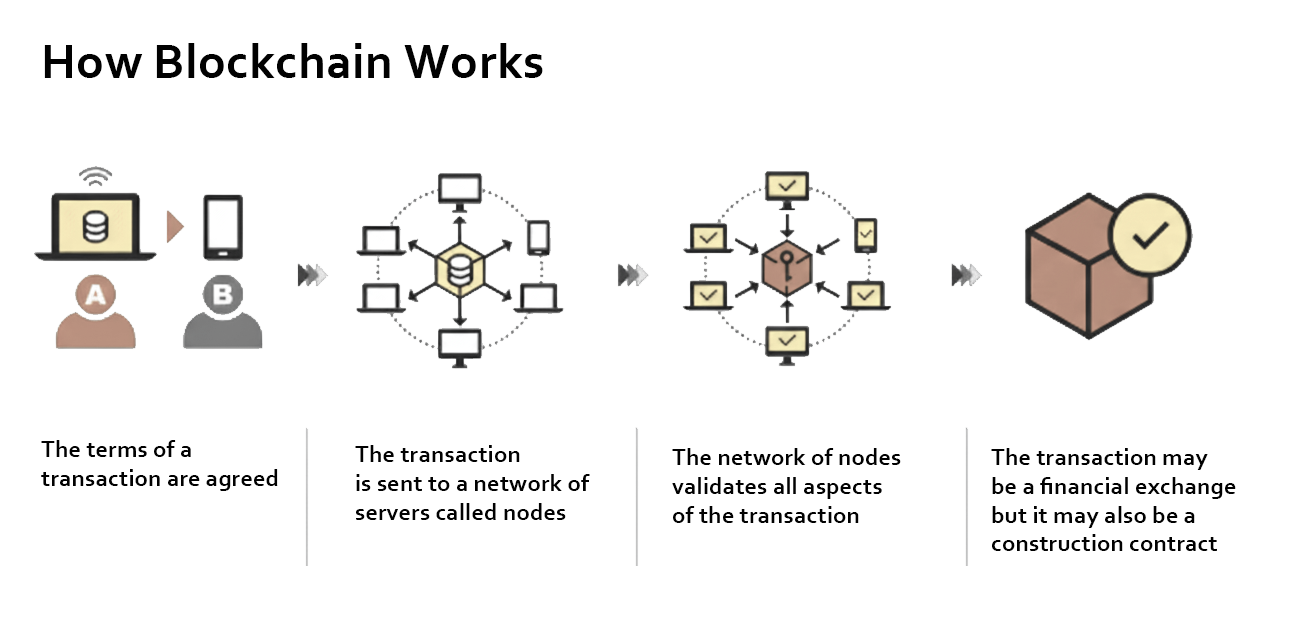
But if we ignore all the hyperbole and look again at what an Ethereum-type blockchain involves – a system that has the same secure, tamper-proof data blocks as Bitcoin but also supports smart contracts – you can see how it might be used for things far beyond dodgy money. Anything that needs a secure, verifiable agreement could benefit from a blockchain approach, including many of the processes that underpin building and construction.
One of the more interesting examples so far of the use of blockchain in the broader construction/real estate space has been in property transactions and land registration. Anyone who’s ever bought a house, no matter where, will know that the process is slow, bureaucratic, paper-heavy and prone to error. Blockchain offers a secure, transparent alternative. In recent years Georgia (the country, not the US state), Dubai, Sweden and other jurisdictions have been testing out blockchain systems to record transfer of title. Media reports suggest the trials have been generally successful with transactions being completed sometimes in a matter of minutes.
In construction, the potential is just as easy to imagine. Take the example of a contractor completing the installation of a complicated foundation on a new project. Instead of waiting weeks for manual inspections to take place, on-site sensors confirm in real time that the work meets the agreed technical specification. That verification is automatically logged on a blockchain, which triggers immediate payment. Large companies like Skanska and Bechtel have been experimenting with these and similar approaches for quite some time, tracking materials from their source to their final installation as well as checking authenticity and compliance.
Another interesting area for potential blockchain crossover is the use of BIM. In a big public building project the architect, engineers and contractors might each start out working on the same 3D BIM model. But as the job progresses, each consultant makes one tweak here and another one there and soon various "official" versions of the same model have come into existence. When a dispute eventually erupts over whether a particular detail was formally approved, no one can be sure whose version of the detail is the “real” one.
With a blockchain-based approach, each approved version of the BIM model could be time-stamped and stored in a tamper-proof way so that a clear, verifiable record of what was agreed can be referred to. We could take this concept one step further and link the approved building model to a city’s digital twin – say, Dublin or Cork – with the building’s latest data slotted straight into the digital city model. This would mean that planners, utility providers and emergency services would have a reliable, up-to-date digital version of the building to work from. And, in fact, this is something that is already being explored in Dublin where the City Council’s partnership with DCU on creating a digital twin has received favourable coverage in the trade press.
While there has been progress in these and other areas, particularly in the private/commercial sphere, wide-scale adoption of blockchain technology in the worldwide construction industry faces a number of hurdles. For a start, regulations vary widely from region to region, making international coordination difficult. Added to that, the technology’s reputation still suffers from its early association with international criminal activity and, more recently, its environmental credentials have also been called into question. Similar to the technology involved in AI, conventional blockchain technology depends on large, power-hungry infrastructure which raises legitimate concerns about energy use and environmental impact, although it must be noted that more recent developments in the field have significantly reduced the amount of electricity to power an Ethereum-type chain.
In Ireland, there’s the added challenge of slow adoption in the public sector. The Government’s recently revised National Development Plan makes passing reference to AI, but none to blockchain. And while some of the important crypto exchanges like Coinbase and Kraken have an established presence in Dublin, there isn’t a sense that blockchain technology has made an impression on the national psyche just yet. Without a clear strategy at government level, we risk falling behind countries already using the technology to speed up land transactions and improve on the construction workflow. How a more streamlined AI/blockchain approach could improve the delivery of, for example, much needed public housing is an interesting point to consider.
This doesn’t mean we should simply bemoan our misfortune and sit around waiting for the next tech opportunity to come our way. One of the more interesting things about the rise of AI, taken in its broadest sense, is its ability to tackle problems that feel too big or too unwieldy for heavy bureaucracies to sort out. So there’s no reason we couldn’t use AI to help us work through the practical and policy challenges of bringing blockchain into our construction and property systems. If we could get the two technologies working together – AI to design streamlined processes, blockchain to guarantee their integrity – the results could be extremely positive for everyone involved. And the countries that manage to combine AI and blockchain in this way will almost certainly enjoy some real advantages. There’s still an opporutnity for Ireland to put itself out in front – but time is running out.
Blockchain can offer a secure, transparent way to record agreements, and therefore holds potential across construction and property sectors, enabling real-time verification, automating payments, and improving data reliability. Yet its adoption in this context remains limited. In this article, Garry Miley discusses the possible impacts and limitations to the technology’s implementation.
Read
Open House Europe has chosen Future Heritage as its theme for this year.[i] This reframing of “heritage” urges us to consider not only what we have inherited from past generations, but what we would like to pass down to future generations. We are custodians of what we have inherited but we cannot preserve our cities to the point of stagnation. While building for the present, we must also negotiate a relationship to the past and to the future.
In considering the importance of the past and the future in the built environment, it is helpful to first consider the nature of the human relationship to time. This was explored by the philosopher Augustine of Hippo (354–430). In his reflections on the nature of time, Augustine speculates that where the past and the future actually exist is in the mind. The past and the future are present in the mind through memory and expectation, respectively. Augustine refers to this as the distention of the mind.[ii] In the human experience of time, then, the mind is always stretched towards the past through memory, and towards the future through expectation.
In this account, the past only exists through memory. However, memory also extends beyond our minds through the act of inscription. Inscription is described by the philosopher Paul Ricoeur as “external marks adopted as a basis and intermediary for the work of memory”.[iii] These “external marks” are what make up our written and visual histories and cultural narratives; crucially, they also make up our built environment. Our cities act as an intermediary for the work of memory. This is captured by Italo Calvino in his book Invisible Cities:
The city, however, does not tell its past, but contains it like the lines of a hand, written in the corners of the streets, the gratings of the windows, the bannisters of the steps, the antennae of the lightning rods, the poles of the flags, every segment marked in turn with scratches, indentations, scrolls.[iv]
Layers of past inhabiting are inscribed in the buildings, streets, and squares of our cities. In our built heritage, we encounter the values and cultural narratives that previously guided the building of our cities. We reinterpret these through the lens of current sociocultural values in a perpetual renegotiation with the past. This is the work of memory.
The relationship to the past, cultivated through this work of memory, is an important aspect of the collective identity of any community. This is the case whether the place is one we have inhabited all our lives or is one that is inscribed with an unfamiliar past. For this reason, built heritage has a powerful role in the sense of identity of the inhabitants of the city. Its loss through war, natural disaster, decay, or development is often met with grief and even outrage.
In this regard, developing a city is a question of considering what memories we consider worth preserving and what future memories we would like to inscribe. The tricky balance of negotiating the relationship between the past and the future in a city can be seen in two late twentieth-century transport-infrastructure-led development projects: one in Amsterdam and one in Dublin.

In the 1970s, the city of Amsterdam’s development plan included the demolition of a large part of the central historic neighbourhood of Nieuwmarkt to make way for the city’s metro. The project proposed to replace the demolished buildings with New-York-style skyscrapers. At around the same time, the Irish transport authority planned to demolish much of the Temple Bar area in Dublin to develop a central bus station and underground rail tunnel. The historic neighbourhoods proposed for the sites of these projects were both in decline and in need of regeneration. The city authorities saw the opportunity this provided for introducing transport infrastructure for the future. A key difference in the circumstances of these projects was that Amsterdam’s had project funding readily available from government and commercial backers; Dublin’s did not.
In Amsterdam, many Nieuwmarkt buildings that had been cleared of their residents in preparation for demolition were occupied by artists and conservationists in an effort to preserve them. However, this local opposition to the demolition did not prevent it from going ahead. Instead, it culminated in some of the city’s worst ever riots, with violent clashes between those who had taken up residence in the district and the police and army sent to forcibly remove them.

Like Nieuwmarkt, Dublin’s Temple Bar area was in need of regeneration as a result of years of decline. However, in this case, funding delays led to the state transport authority letting out the properties it had acquired and earmarked for demolition. The cheap short-term rents attracted artists and small businesses. This brought new life to the area and revealed its potential as a cultural quarter. With intensifying local resistance to the plan and a new civic consciousness of the area’s potential, plans for the bus station were abandoned.
In Dublin, as in Amsterdam, there was a dissonance between the values of those altering the city and the values of those inhabiting the city. However, the delays to the Dublin project sowed the seeds of an alternative approach to the area’s development. Eventually, as part of Dublin’s tenure as European City of Culture in 1991, a competition for the rehabilitative Temple Bar Framework Plan was launched. This was won by Group 91[v] with their plan that proposed preserving much of the existing network of streets, with a handful of interventions including squares, streets, and a few key buildings.
Similarly, in Nieuwmarkt, even though a large number of buildings were demolished and the metro was built, plans for a motorway and tall office buildings were abandoned and Nieuwmarkt was ultimately rebuilt on its original street layout. This is notable as memory is not only inscribed in the materiality of the city, but also in its layout and design. In his book The Poetics of Space, Gaston Bachelard points out that “over and beyond our memories [our formative space] is physically inscribed in us. It is a group of organic habits”.[vi] Memory is inscribed in our cities, and the space of our cities is in turn inscribed in us through choreographing our habits of use.[vii]

Learning from past instances is valuable in deciding how to develop our future heritage and recognising what values are driving our decisions. It is evident from the above examples that changes to a city should be approached with care and follow the “principles of cooperation, equity, and democracy”[viii] that underpin much of Europe’s recent history. A good guiding principle to making interventions in the city that create inclusive socially responsible future heritage is perhaps the generosity of spirit invoked by Grafton Architects' concept of “freespace”.[ix] This includes generosity to current inhabitants through collaboration and the promotion of agency and belonging, and generosity to future inhabitants, particularly by taking measures to mitigate climate change and to make our cities inhabitable in the future.
Like the mind in Augustine’s account of time, the city is stretched towards both the past and the future. Our own values determine how we approach our relationship to the past and what we desire for current and future inhabitants. Where the future exists as expectation in the mind, it exists as possibility in the built environment. The past is present in the built heritage of a site and the future is present in the possibilities that the site presents. In deciding how to alter our urban spaces we are renegotiating our relationship to our past and drawing out the city we want future generations to inherit.
In this article, Dr Sally J. Faulder, referencing this year's Open House Europe theme of "Future Heritage", considers how we ascribe value to our inherited and inhabited built fabric, and to the built heritage we seek to pass on.
Read

Website by Good as Gold.